
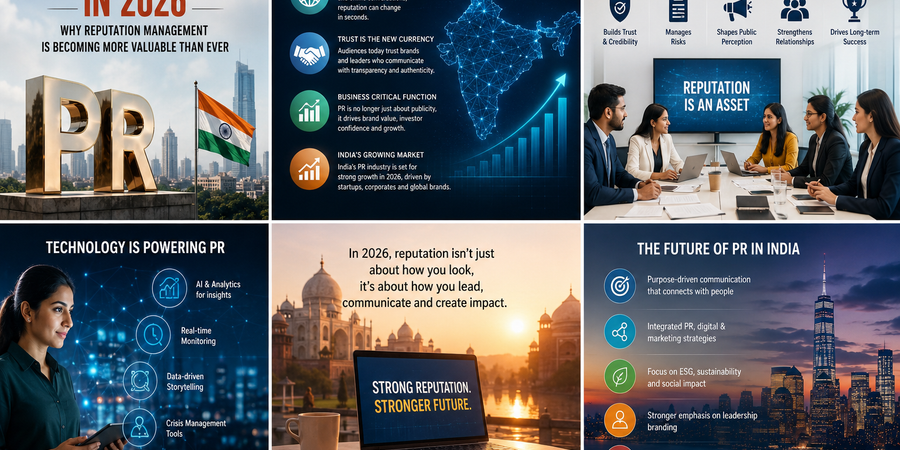
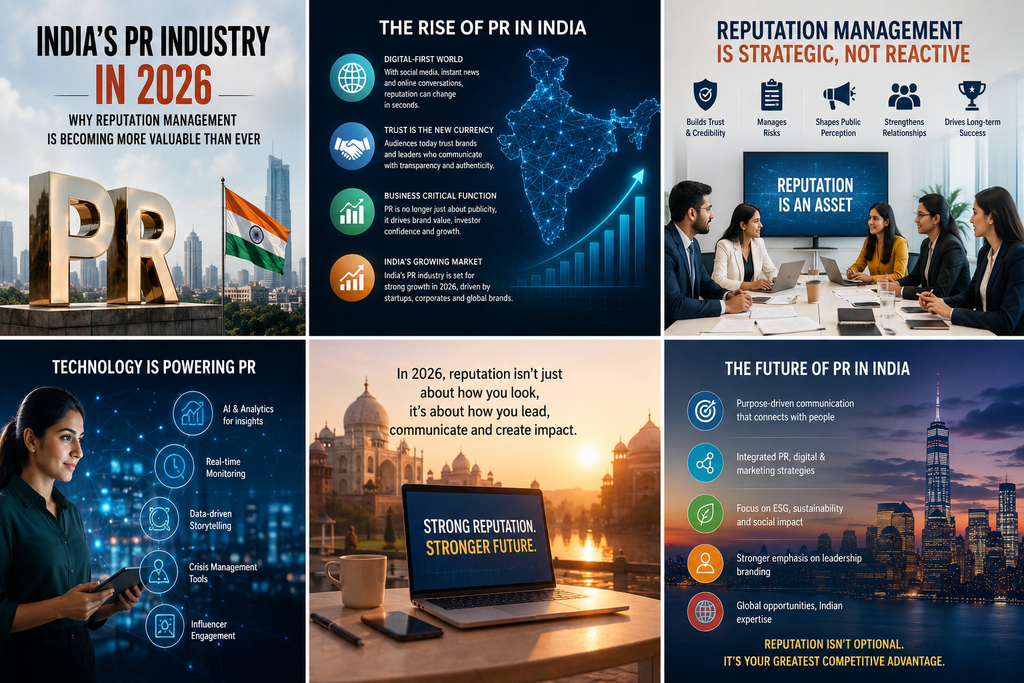
The figure comes from an Ipsos white paper commissioned by the Public Relations Consultants Association of India (PRCAI) and unveiled on 2 September 2026 at PRana 2026, the association’s flagship Brand India Reputation Summit in Gurugram. Titled “The Economic Impact of Public Relations in India,” the paper does not claim the $545 billion as industry revenue. Instead, it models the broader economic consequences of PR activity across three levers: reputation management ($265 billion), revenue sustainability and growth through brand awareness ($220 billion), and crisis mitigation ($60 billion).
The timing is deliberate. India’s PR market has expanded 11 per cent year-on-year to ₹3,230 crore in FY2026, according to PRCAI’s SPRINT 2026 report, also prepared with Ipsos and Astrum Reputation Advisory. The industry now accounts for 12.6 per cent of the Asia-Pacific PR market and is projected to reach ₹4,500 crore by 2030. Growth has moderated from a decade-long compound annual rate of roughly 12 per cent, signalling a maturing profession that is shifting from pure volume expansion to deeper strategic influence.
Reputation as the Largest Economic Lever
Reputation management emerges as the single biggest contributor at $265 billion. The calculation draws on established investor-relations research showing that approximately 28 per cent of investor decision-making is influenced by a company’s reputation. Isolating the portion attributable to public relations activity and applying it to India’s listed market capitalisation of roughly $4.5–4.75 trillion produces the $265 billion estimate.
In an economy where market capitalisation has grown rapidly and retail as well as institutional investors scrutinise governance, ESG performance and founder narratives, reputation has moved from intangible soft asset to measurable financial variable. Corporate communication leaders surveyed for the SPRINT report underline the point: 96 per cent say PR builds investor confidence, the same share links it to customer loyalty, 92 per cent credit it with stronger stakeholder relationships, 83 per cent with crisis resilience, and 75 per cent with long-term revenue growth. PR’s share of overall marketing budgets has risen correspondingly, from 12 per cent in FY25 to 14 per cent in FY26.
The practical implication is clear. Boards that once treated communications as a downstream support function now confront evidence that systematic reputation work can protect and enhance hundreds of billions of dollars in enterprise value. Founder-led startups preparing for IPOs, listed companies navigating activist scrutiny, and conglomerates managing multi-stakeholder ecosystems all find that narrative consistency, transparency and proactive engagement translate into lower cost of capital and higher multiples.
Brand Awareness and Revenue Sustainability
The second lever—revenue sustainability and growth through brand awareness—accounts for an estimated $220 billion. Researchers examined PR’s contribution across nine major sectors: IT and software services, banking and financial services, FMCG, automotive, healthcare and pharmaceuticals, hospitality and tourism, aviation, startups/tech unicorns and e-commerce, and education and edtech. Applying the isolated PR share to an adjusted organised-sector base of approximately $1.2 trillion yields the figure.
In India’s high-growth, high-competition environment, brand discovery no longer occurs solely through paid media. Earned media, regional storytelling, influencer ecosystems and large-language-model visibility increasingly determine whether a product or service enters the consideration set. PR agencies have expanded far beyond traditional media relations into integrated programmes that combine digital communications, influencer engagement, public affairs and analytics-led strategy. The result is a measurable contribution to top-line resilience even when advertising budgets fluctuate.
Startups illustrate the dynamic vividly. Their share of top PR client categories has nearly quadrupled from 6 per cent in 2022 to 22 per cent in 2026. Founder brands, venture-backed companies and those preparing for public markets invest heavily in credibility-building communications that support customer acquisition, talent attraction and fundraising. Education, edtech and FMCG have also emerged as high-growth client segments.
Crisis Management: The $60 Billion Shield
Crisis mitigation contributes the remaining $60 billion. The study analysed more than 90 major crises involving leading revenue-generating brands over the past decade—covering brand backlash, product safety failures, operational disruptions, governance and financial misconduct, and cyber incidents. Average impacts observed were 0.35 per cent revenue erosion and 1.5 per cent market-capitalisation erosion. Disaggregating the protected value produces roughly $4 billion in revenue and $56 billion in market capitalisation.
Sectoral exposure varies. Startups, tech unicorns and e-commerce face the highest estimated annual value at risk at approximately $12.8 billion, followed by aviation at $8.9 billion and healthcare and pharmaceuticals at $7.2 billion. In a hyper-connected media environment where a single video, deepfake or regulatory tweet can travel nationally within hours, the ability to respond with speed, accuracy and credibility has become a core enterprise risk-management capability.
Fake-news incidents reported by corporate communicators nearly doubled from 28 per cent in 2024-25 to 46 per cent in 2025-26. Eighty per cent of respondents now flag AI-generated misinformation and deepfakes as a top reputational risk. The same technology that accelerates content production and insight generation simultaneously multiplies the vectors of attack. Effective crisis PR therefore encompasses not only rapid response protocols but continuous monitoring, pre-emptive narrative work and governance frameworks for AI-generated content.
Structural Shifts Reshaping Demand
Beyond the economic modelling, the SPRINT 2026 report documents profound changes in who buys PR and why. Government organisations’ share of top client categories has nearly tripled from 4 per cent in 2022 to 11 per cent in 2026. Private corporates, long the industry’s mainstay, have slipped from 48 per cent to 42 per cent. The rise of public-sector and government-linked mandates reflects greater emphasis on citizen communication, policy advocacy and nation-branding efforts.
Geography is also shifting. PR revenue originating outside the metros has nearly doubled from 10 per cent three years ago to 19 per cent in 2026 and is projected to reach 25 per cent. Sixty-five per cent of corporate communicators identify tier-two cities as the primary growth engine. As consumption, entrepreneurship and media ecosystems expand beyond the traditional metros, agencies are building regional capabilities and vernacular content strategies.
Influencer marketing now accounts for roughly 16 per cent of industry revenue, yet almost all participants call for stronger verification and regulatory standards amid authenticity concerns. The boundary between PR and broader marketing continues to dissolve: 58 per cent of respondents say PR is expanding into marketing-performance outcomes, and 53 per cent report it is gaining budget share from advertising and digital agencies.
Artificial Intelligence: Opportunity and Fragmentation
AI investment has more than tripled from 2 per cent of industry revenue three years ago to 7 per cent in FY2026, with expectations of reaching 10 per cent within three years. Applications concentrate on research and intelligence gathering, content creation and meeting summarisation. Yet adoption strategies diverge sharply by agency size. Large firms prioritise enterprise-scale analytics and narrative intelligence platforms; mid-sized and boutique agencies experiment with more agile, tool-specific deployments.
Risks are equally prominent. Beyond deepfakes and misinformation, 61 per cent of respondents warn that AI is commoditising creativity. Eighty-five per cent believe formal AI governance frameworks will become essential. The profession is therefore entering a dual track: using AI to deliver faster, more precise insights while simultaneously developing human judgement, ethical guardrails and differentiated strategic counsel that machines cannot replicate.
From Support Function to Boardroom Agenda
The cumulative picture is of a profession at an inflexion point. Kunal Kishore Sinha, President of PRCAI, framed the $545 billion figure not as a revenue claim but as a measure of consequence: “An industry of our size does not merely support business; it actively shapes the conditions under which businesses grow, survive crises, and retain the trust of investors and consumers alike.” Deeptie Sethi, CEO of PRCAI, noted that the moderation in growth rate reflects maturation in line with global trends, with greater emphasis on client mix, outcomes and strategic relevance.
In practical terms, reputation management is becoming more valuable because the cost of reputation failure has risen dramatically while the upside of reputation strength has become more quantifiable. India’s capital markets, startup ecosystem, export ambitions and digital public sphere all amplify the stakes. A poorly handled product recall, governance lapse or cultural misstep can erase market value far exceeding the annual PR budget of most organisations. Conversely, consistent, credible communication supports valuation premiums, customer retention and regulatory goodwill.
Agencies have responded by broadening service portfolios. Integrated reputation management, crisis advisory, public policy consulting, ESG and sustainability communications, and analytics-led strategies now sit alongside traditional media relations. Demand for specialists in healthcare, technology, financial services and public affairs continues to grow. Talent models are adapting, with greater emphasis on data literacy, sector expertise and the ability to counsel at C-suite and board level.
Looking Ahead
Projections to ₹4,500 crore by 2030 assume continued double-digit or high-single-digit expansion driven by the same structural forces already visible: startup and IPO activity, government communication needs, regional market development, and the rising allocation of marketing budgets to reputation and earned-media work. The $545 billion economic-impact estimate, if sustained or expanded as India’s market capitalisation and organised-sector revenue grow, will further elevate the strategic status of the function.
Challenges remain. Measurement of PR outcomes is still fragmented; 92 per cent of respondents call for standardised metrics, yet fewer than half allocate dedicated budgets to track them. Authenticity in influencer ecosystems, regulation of AI-generated content, and the risk of creativity commoditisation require industry-wide responses. Competition for specialised talent is intense, and smaller agencies must navigate the capital and capability requirements of advanced analytics platforms.
Nevertheless, the central narrative of 2026 is unambiguous. Reputation is no longer a peripheral concern or a post-crisis repair job. It is an economic asset whose management influences hundreds of billions of dollars in investor decisions, revenue streams and protected value. India’s PR industry, though still modest in absolute revenue terms relative to advertising or digital marketing, has demonstrated outsized consequence. As boards, founders and policymakers internalise that evidence, the profession’s seat at the strategic table appears increasingly secure—and increasingly valuable.
The white paper and SPRINT findings together mark a maturation milestone. What began decades ago as media relations has evolved into a discipline that quantifies and protects enterprise value in one of the world’s most dynamic economies. In 2026, that evolution is no longer aspirational. It is measurable, material, and more critical than ever.




Leave a Reply