
Introduction
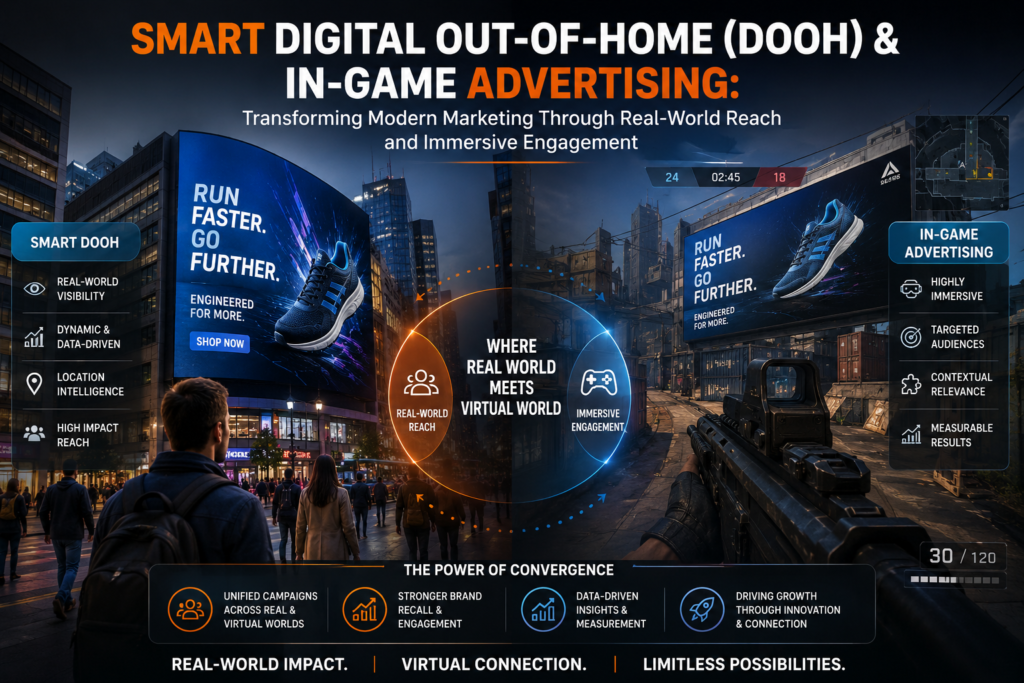
In an era where consumer attention is fragmented across physical and digital realms, advertisers are turning to two powerful, evolving channels: Smart Digital Out-of-Home (DOOH) advertising and In-Game Ads. Smart DOOH transforms traditional billboards, transit screens, and public displays into dynamic, data-driven platforms capable of real-time personalisation and contextual relevance. In-Game advertising embeds brands seamlessly into interactive virtual environments, capitalising on the deep engagement of over 3 billion gamers worldwide.
These formats represent a shift from passive, one-size-fits-all messaging to intelligent, measurable, and immersive experiences. Global DOOH markets are projected to grow significantly, with estimates around USD 20-23 billion in the mid-2020s, aiming for USD 39-56 billion by 2030-2034 at CAGRs of 10-12%. In-game advertising markets show similar momentum, with valuations around USD 9-11 billion recently and forecasts reaching USD 20-33 billion by 2030-2035, driven by mobile gaming and immersive formats.
This article explores the evolution, technologies, benefits, challenges, case studies, comparisons, and future trajectories of these channels, highlighting their potential synergy in a connected advertising ecosystem.
The Evolution and Rise of Smart Digital Out-of-Home (DOOH)
Out-of-Home (OOH) advertising has long been a staple for broad reach, but the digital shift has revolutionised it. Traditional static billboards gave way to digital screens in the early 2000s, enabling content rotation and brighter visuals. “Smart” DOOH adds layers of intelligence through AI, real-time data, programmatic buying, and connectivity.
By the mid-2020s, DOOH accounts for a growing share of total OOH spend—often over 30-40% in mature markets—with programmatic DOOH seeing explosive growth (e.g., 22%+ YoY in some projections). North America leads, but global expansion into street furniture, airports, retail, and transit networks accelerates adoption. Key drivers include urbanisation, smartphone proliferation for measurement, and the need for non-intrusive advertising amid cord-cutting and ad fatigue on digital platforms.
Smart DOOH stands out through its ability to respond to environmental cues. Screens adjust content based on weather, time of day, traffic, or local events, making ads hyper-relevant.
Technologies Powering Smart DOOH
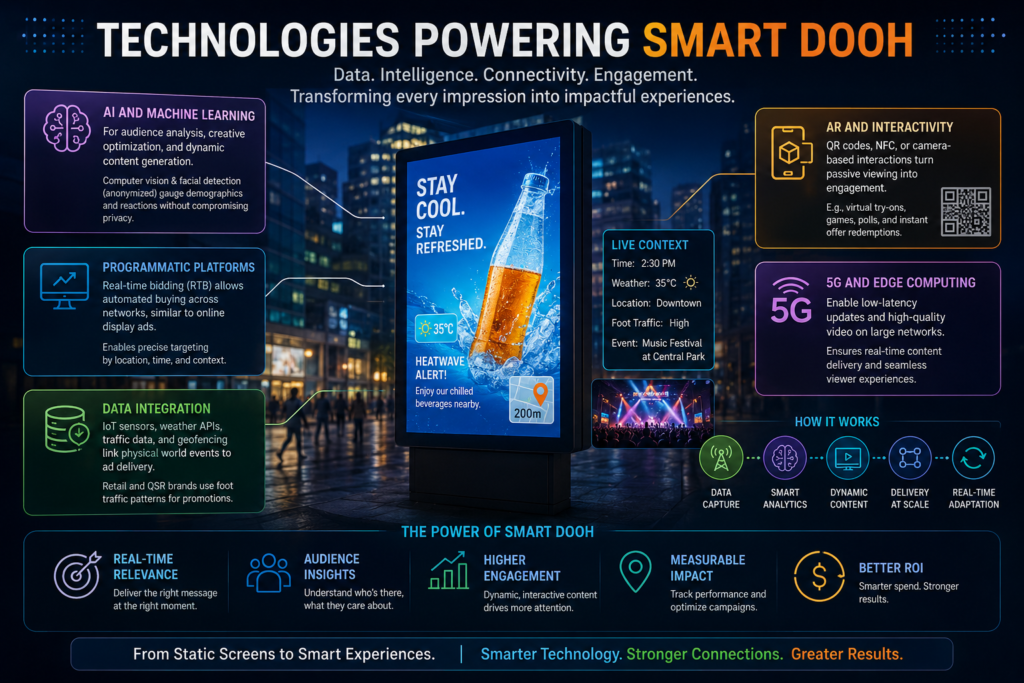
Several technologies converge in Smart DOOH:
- AI and Machine Learning: For audience analysis, creative optimisation, and dynamic content generation. Computer vision and facial detection (anonymised) gauge demographics and reactions without compromising privacy.
- Programmatic Platforms: Real-time bidding (RTB) allows automated buying across networks, similar to online display ads. This enables precise targeting by location, time, and context.
- Data Integration: IoT sensors, weather APIs, traffic data, and geofencing link physical world events to ad delivery. Retail and QSR brands use foot traffic patterns for promotions.
- AR and Interactivity: QR codes, NFC, or camera-based interactions turn passive viewing into engagement (e.g., virtual try-ons near stores).
- 5G and Edge Computing: Enable low-latency updates and high-quality video on large networks.
These tools allow campaigns to shift from static rotations to adaptive storytelling. For instance, a beverage brand might promote cold drinks during heatwaves or pair ads with nearby events.
Benefits and Challenges of Smart DOOH
Benefits:
- High Visibility and Recall: DOOH often outperforms other media in favorability (73% favorable views) and action-driving (76% of viewers took action). It excels in brand lift for awareness and intent.
- Contextual Relevance: Real-world alignment boosts effectiveness.
- Measurability: Integration with mobile and online data allows attribution via geofencing and cross-channel tracking.
- Scalability: Programmatic access lowers barriers for smaller advertisers.
- Sustainability Edge: Digital formats reduce print waste.
Challenges:
- Privacy Regulations: GDPR, CCPA, and local laws limit data collection. Anonymised analytics are key, but facial recognition raises concerns.
- Infrastructure Costs: High upfront investment for screens and maintenance.
- Ad Clutter: Over-saturation in urban areas can reduce impact.
- Measurement Standardisation: While improving, cross-platform attribution lags behind digital channels.
History and Types of In-Game Advertising
In-game ads trace back to early arcade and console titles with static product placements. The rise of free-to-play (F2P) mobile games in the 2010s exploded the market, turning games into ad-supported platforms. Dynamic serving and programmatic integration marked the “smart” evolution.
Main Types:
- Static Ads: Baked-in placements (e.g., fixed billboards). Reliable but inflexible.
- Dynamic Ads: Real-time served content, geo-targeted or personalised (e.g., rotating billboards in racing games).
- Product Placement / Branded Integrations: Native items, skins, vehicles, or narrative elements.
- Rewarded/Playable Ads: Players opt-in for rewards; interactive mini-experiences.
- Esports and Livestream Overlays: Sponsorships in competitive viewing.
Mobile dominates due to scale, but PC/console and cloud gaming expand premium opportunities.
Technologies and Trends in In-Game Ads
- Programmatic and Dynamic Insertion: Ad networks serve context-aware creatives without game updates.
- AI for Personalisation: Tailors ads to player behaviour, demographics, or playstyle while respecting privacy.
- Immersive Formats: AR/VR integrations, metaverse experiences, and haptic feedback.
- First-Party Data: Games provide rich contextual signals (e.g., location in open-world titles, preferences via gameplay).
- Blockchain/NFTs: For verifiable ownership of branded virtual goods (emerging).
Trends include non-intrusive intrinsic ads (high viewability ~98%), rewarded videos, and cross-promotions with esports.
Benefits and Challenges of In-Game Ads
Benefits:
- Deep Engagement: Gamers are attentive; intrinsic ads achieve high viewability and attention metrics superior to many digital formats.
- Targeted Demographics: Young, tech-savvy audiences, including Gen Z/Alpha.
- Brand Lift: Studies show strong recall, favorability, and purchase intent, especially with native integrations.
- Scalability and Measurability: Programmatic tools, analytics dashboards, and attribution models.
- Creative Freedom: Interactive storytelling in virtual worlds.
Challenges:
- Brand Safety: Avoiding inappropriate contexts requires robust moderation.
- Player Experience: Intrusive ads can cause churn; native is preferred.
- Fragmentation: Many platforms and publishers complicate buying.
- Privacy and Regulation: COPPA for younger players, GDPR for data; consent management is critical.
- Measurement: Attribution in closed gaming ecosystems can be tricky.
Case Studies
Smart DOOH:
- British Airways “Magic of Flying”: Used radar data to highlight real flights on billboards, creating wonder and demonstrating network reach.
- PODS Moving: AI-generated hyperlocal messages on truck billboards across NYC neighbourhoods, driving 60% website visit increase.
- Coca-Cola and others have used smile-detection or weather-reactive campaigns for engagement.
In-Game:
- Sony INZONE in Asphalt 9 (Gameloft): Intrinsic headphone placements boosted realism and awareness.
- SUPERPRETZEL: Achieved significant brand lift via immersive integrations.
- Automotive brands in racing games and fashion in lifestyle titles demonstrate native success.
These examples show tangible ROI through engagement and lift metrics.
Comparison: Smart DOOH vs. In-Game Ads
DOOH excels in broad, location-based awareness with real-world contextual power—ideal for impulse buys, local promotions, and mass reach. It feels “public” and unavoidable in high-traffic areas. In-Game ads offer deeper, opt-in engagement in controlled virtual spaces, suiting lifestyle branding, product education, and younger demographics.
Similarities: Both leverage data for relevance, support programmatic buying, and prioritize non-disruptive experiences. High measurability and brand safety focus unite them.
Differences: DOOH is passive/public/physical-hybrid; In-Game is active/private/virtual. DOOH benefits from serendipity in daily commutes; In-Game from sustained attention during play sessions. Cost models vary—DOOH often CPM-based on impressions, In-Game on engagement or performance.
Effectiveness: DOOH drives immediate actions; In-Game builds emotional connections and recall. Combined, they cover omnichannel journeys.
Future Trends and Integration
The future points to convergence. Metaverse and AR blur lines between physical DOOH and virtual in-game worlds, enabling “Metaverse DOOH” with shared branded assets across realities.
- AI-Driven Omnichannel: Unified platforms for cross-environment campaigns (e.g., DOOH exposure triggering in-game offers).
- Privacy-First Innovation: Contextual targeting over personal data; zero-party data and consent tech.
- Sustainability and Inclusivity: Energy-efficient screens, diverse representations.
- Immersive Tech: 5G, spatial computing, and generative AI for hyper-personalized creatives.
- Esports and Hybrid Events: Blending live physical DOOH with virtual streaming.
By 2030+, these channels could integrate seamlessly, with gaming influencing real-world ads and vice versa.
Conclusion
Smart DOOH and In-Game Ads embody the next frontier of advertising: intelligent, engaging, and adaptive to human behavior across physical and digital domains. With robust growth trajectories, technological maturation, and proven effectiveness, they offer advertisers powerful tools to cut through noise. Success hinges on creativity, ethical data practices, brand safety, and seamless integration. Brands that master both—leveraging DOOH for scale and awareness, In-Game for depth and loyalty—will thrive in the attention economy. The synergy promises a future where advertising enhances experiences rather than interrupting them, fostering genuine connections in an increasingly blended world.
===




Leave a Reply