
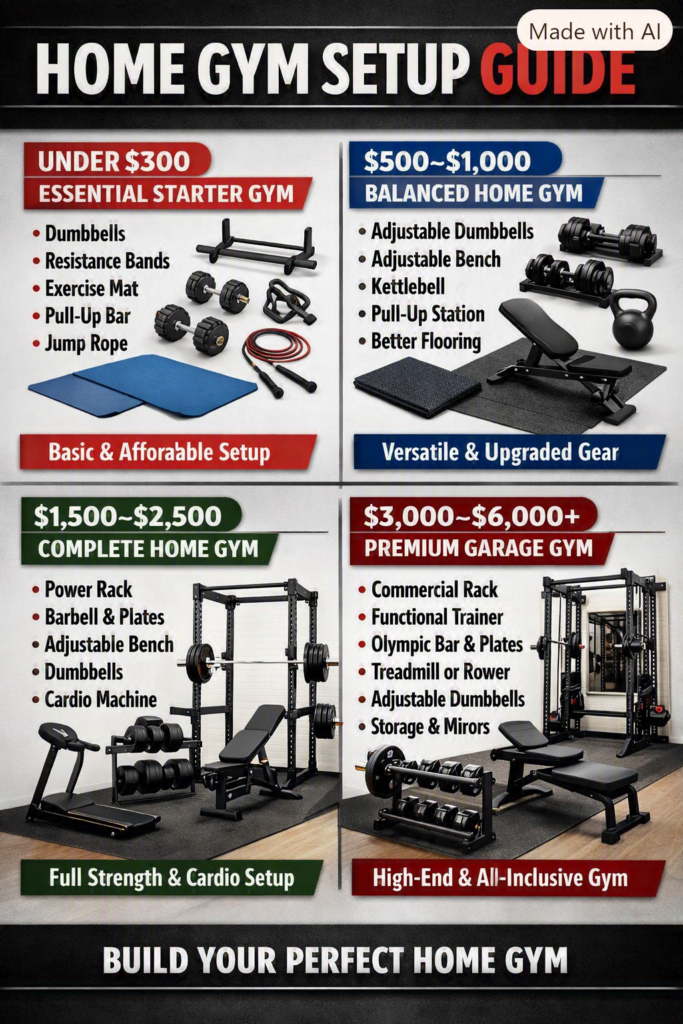
The U.S. home fitness equipment market continues to show resilience. After the pandemic-era boom and subsequent normalisation, demand remains strong for versatile, space-efficient, and connected products. Average home gym setups vary widely depending on goals and square footage, but most functional systems fall between $1,000 and $5,000, with premium builds exceeding that range. Prices reflect the quality of materials, durability, smart features, and inflation-related increases over the past decade.
Why Invest in Home Fitness Equipment?
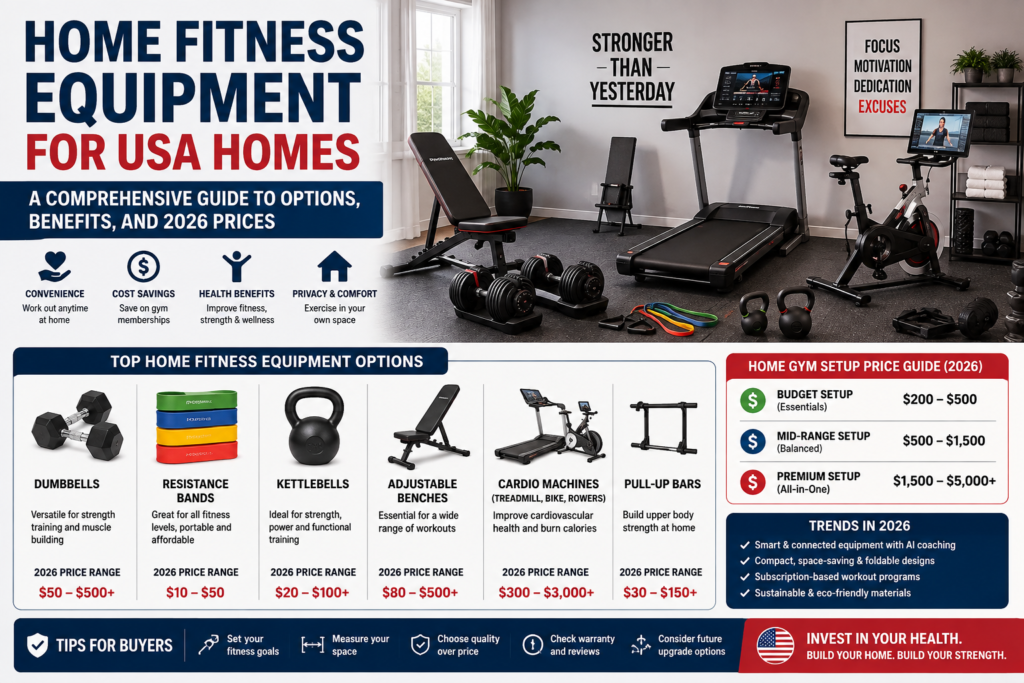
Home gyms eliminate commute time, crowded facilities, and monthly fees that often range from $40 to $100 or more. They allow workouts at any hour, support consistent habits, and can be tailored to specific goals such as strength building, cardiovascular health, weight loss, mobility, or rehabilitation. For families, shared equipment multiplies value. Many Americans also appreciate the privacy and hygiene control of training at home.
Key benefits include progressive overload through adjustable resistance, full-body training options, and the ability to combine strength and cardio without leaving the property. However, success depends on choosing gear that matches available space, floor load capacity, noise tolerance (especially in apartments or shared walls), and realistic usage patterns. Overbuying leads to unused equipment, while underbuying limits progress.
Essential Factors Before Buying
Space constraints dominate decisions in U.S. homes. Apartments and smaller houses favour foldable, wall-mounted, or adjustable items. Garages and basements accommodate larger racks and machines. Measure ceiling height for pull-up bars or squat racks, check floor strength for heavy plates, and consider ventilation and lighting.
Budget tiers typically break down as follows in 2026:
- Minimalist/budget: $100–$800
- Starter/functional: $800–$2,000
- Core/complete: $2,000–$4,000
- Premium/full: $4,000–$10,000+
Training goals guide priorities. Strength-focused users prioritise free weights and racks. Cardio enthusiasts need treadmills, bikes, or rowers. Hybrid athletes benefit from all-in-one functional trainers or smart systems.
Safety and durability matter. Look for weight capacities exceeding expected loads, stable bases, and warranties of several years. Flooring protection (rubber mats or stall mats) prevents damage and reduces noise. Proper form education reduces injury risk when training solo.
Smart features and subscriptions add cost. Connected machines often require monthly fees of $30–$50 for classes and tracking. Factor these into long-term expenses.
Where to buy: Amazon, Best Buy, Rogue Fitness, REP Fitness, and brand sites dominate. Watch for sales around Prime Day, holidays, and end-of-year clearances. Used markets (Facebook Marketplace, Craigslist) offer savings but require careful inspection.
Strength Training Equipment
Strength training forms the foundation of most effective home gyms because free weights and basic machines deliver high return on investment through compound movements.
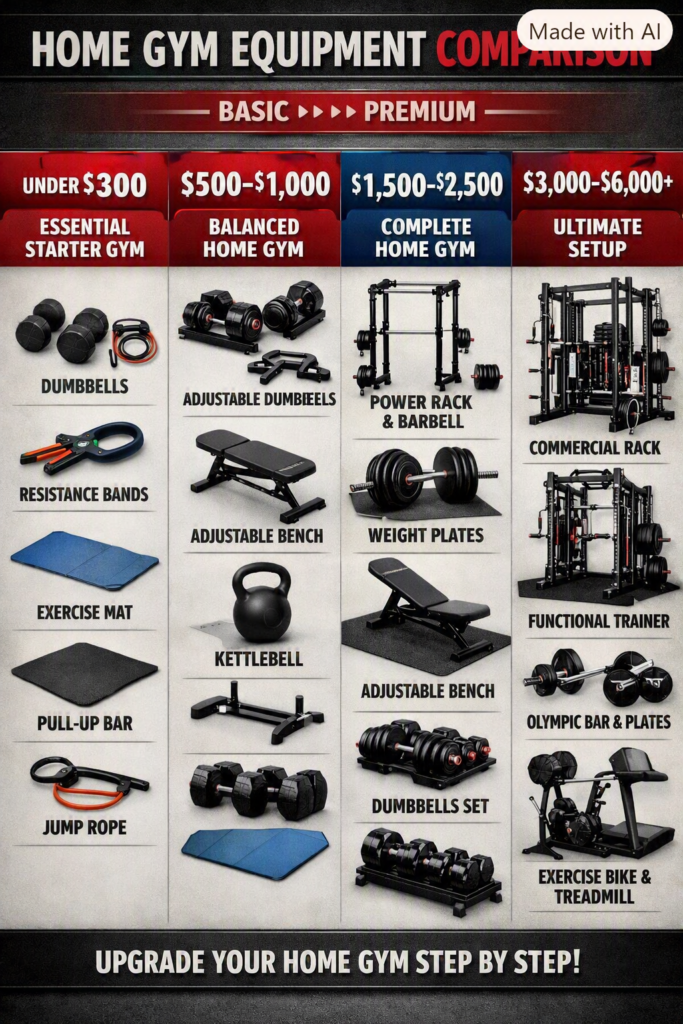
Adjustable dumbbells rank among the best space-saving purchases. Traditional fixed dumbbells require racks and significant floor space; adjustable sets replace dozens of pairs. Popular options like the Bowflex Results Series 552 (5–52 lbs per dumbbell) typically retail around $350–$430, with frequent sales near $330–$400. Higher-capacity models or PowerBlock-style systems can reach $400–$1,300 depending on max weight. Budget adjustable pairs start near $200–$300. These allow progressive training for presses, rows, curls, and lunges while storing in a small footprint.
Fixed dumbbells and kettlebells suit those preferring a traditional feel. Rubber-coated hex dumbbells cost roughly $1.50–$3 per pound. A basic set from 5–50 lbs with a rack often runs $300–$800. Individual kettlebells range from $20–$50 for lighter weights to $80–$150 for heavier competition-style models. Adjustable kettlebells provide further space efficiency.
Barbells and weight plates enable heavy compound lifts. A quality Olympic barbell (45 lbs) costs $150–$350; premium U.S.-made options from Rogue (Ohio Bar or Power Bar) sit around $300–$315. Iron plates average $1–$2 per pound, so a 300-lb set runs $300–$500. Bumper plates (safer for dropping and floor protection) cost more, often $2–$3+ per pound, pushing a 300–450 lb set toward $600–$1,000. Budget CAP Barbell Olympic sets with bar and plates appear around $250–$350.
Weight benches unlock pressing and other movements. Basic flat benches start under $100. Adjustable models (incline/decline) from Flybird or similar brands commonly sell for $100–$180, with sales near $100–$110. Higher-end adjustable benches from REP or Rogue reach $200–$600. Foldable designs excel in small spaces.
Squat racks, power cages, and stands provide safety for solo lifting. Entry-level power cages or stands cost $200–$400 (examples include Fitness Reality or Ultra Fuego models). Mid-range options from REP or similar run $500–$1,000. Premium Rogue racks (RML series or wall-mounted fold-back) range from $700 to $1,200+. Wall-mounted or foldable designs conserve floor space dramatically. Many include pull-up bars.
Cable machines and functional trainers expand exercise variety. Wall-mounted cable stations start around $180–$350. Full dual-stack functional trainers or all-in-one Smith machines with cables range from $800–$1,500 for solid mid-tier units (RitFit or similar) up to $3,000–$6,000+ for premium Rogue or Force USA systems. These allow rows, flys, pulldowns, and more without free-weight instability.
Accessories such as weight belts ($30–$60), collars, straps, and chalk add modest costs but improve safety and performance.
Cardio Equipment
Cardio machines deliver heart-health benefits and calorie burn. Choose based on joint impact preferences and space.
Treadmills and walking pads remain popular. Basic foldable treadmills start near $400–$700 (Sunny Health models around $700). Mid-range connected options like NordicTrack T Series often sell for $600–$1,300, with higher commercial-style units reaching $2,000–$3,500+. Walking pads (under-desk or compact) provide quieter, lower-impact options at $250–$350 (MERACH or similar). Incline features and larger motors increase price and durability.
Exercise bikes range from basic stationary models at $150–$300 (Yosuda around $200 on sale) to connected spin bikes. Peloton-style bikes typically cost $1,000–$2,500 depending on model and screen features, often with subscription requirements. Air bikes (Assault-style or Rogue Echo) run $800–$1,000+ and excel for high-intensity intervals.
Rowing machines offer full-body, low-impact cardio. Budget magnetic rowers start near $190–$300 (Yosuda). Concept2 RowErg, a durable gold standard, sits around $900–$1,100. Connected options like Hydrow Origin range from $1,500–$2,200, with sales sometimes bringing them lower. Foldable designs help with storage.
Ellipticals and hybrid trainers provide joint-friendly alternatives. Entry models begin around $500–$1,000; quality units reach $1,500–$3,500. Bowflex Max Trainers or similar compact hybrids occupy less space than full ellipticals.
SkiErgs or vertical climbers suit tight spaces but appear less frequently in average homes.
All-in-One Systems and Smart Home Gyms
For users wanting maximum variety in limited space, all-in-one machines and smart systems shine.
Selectorized multi-gyms or functional trainers with weight stacks (150–300+ lbs) range from $600–$1,500 for basic models to $2,000–$5,000+ for advanced Force USA, Major Fitness, or similar systems featuring Smith machines, cable crossovers, and leg stations.
Smart digital systems like Tonal 2 use electromagnetic resistance (up to 250+ lbs) and wall mounting. Prices often land around $3,000–$4,000 with frequent discounts of several hundred dollars. These include AI form feedback, guided workouts, and compact footprints ideal for apartments, though they rely on power and sometimes subscriptions. Other smart options (Speediance, Tempo) occupy similar price bands.
These systems excel for intermediate users seeking guidance but may feel limiting for pure powerlifters needing free-weight loading.
Accessories, Flooring, and Recovery Tools
No home gym is complete without supporting items. High-quality yoga or exercise mats cost $20–$80. Puzzle foam or rubber tiles run $1–$3 per square foot; horse stall mats (durable and affordable) often total $100–$300 for a training area. Resistance band sets with handles and anchors provide $20–$50 of versatile training. Foam rollers ($20–$40), massage guns ($80–$350), jump ropes ($10–$30), and pull-up bars ($25–$80) round out recovery and bodyweight options.
Mirrors, fans, and proper lighting enhance the experience without large expense.
Building by Budget: Sample Setups
Under $500: Adjustable dumbbells or basic fixed set ($200–$350), foldable bench or mat ($50–$100), resistance bands and pull-up bar ($50), basic flooring. Focus on bodyweight and light strength.
$500–$1,500: Add a budget power cage or squat stand ($200–$400), Olympic bar and 200–300 lb plates ($300–$500), better adjustable bench ($100–$150), and a walking pad or basic bike. This covers most compound lifts safely.
$1,500–$3,000: Premium rack ($600–$1,000), quality bar and bumper or iron plates ($500–$900), adjustable dumbbells ($350+), solid bench, Concept2-style rower or mid-tier treadmill, and proper flooring. A complete strength-plus-cardio gym emerges.
$3,000+: Expand with functional trainer attachments, smart system, multiple cardio pieces, commercial-grade components, climate control, and accessories. Rogue or high-end all-in-ones dominate this tier.
Average complete home gyms often land near $2,000–$3,500 for capable, long-lasting setups.
Cost Considerations, Maintenance, and Return on Investment
Prices have risen over the past decade due to inflation, material costs, and demand—dumbbells and cardio machines saw notable increases. Tariffs and supply factors have influenced recent pricing, though sales mitigate the impact.
Ongoing costs include electricity for motorised machines, possible subscriptions ($30–$50/month), and maintenance (lubrication, belt replacement, cable inspection). Budget 5% of initial cost annually for upkeep.
Compared to commercial memberships, a $2,000–$3,500 home gym often breaks even within 2–4 years depending on membership price and usage frequency. After that, savings accumulate significantly while convenience remains.
Practical Tips for American Homeowners
Prioritise multi-use items first. Buy quality over quantity for bars, racks, and benches—these last decades with care. Check return policies and assembly requirements; many heavy items arrive in multiple boxes. Consider noise for multi-unit housing and HOA rules for outdoor setups. Start simple and expand based on actual usage rather than aspirational purchases.
Measure doorways and stairwells for delivery. Factor local sales tax and shipping (heavy items can add $50–$200). Test used equipment thoroughly for wear, especially cables, bearings, and electronics.
For apartments, emphasise adjustable dumbbells, foldable benches, resistance systems, and compact cardio. Garages favour full racks and bumper plates. Basements work well with proper moisture control and flooring.
Trends in 2026
Connected and AI-coached systems continue gaining traction alongside traditional free weights. Compact and modular designs address urban living. Hybrid training (strength + cardio in one session) drives demand for versatile machines. Sustainability and U.S.-made options appeal to some buyers despite higher prices.
Recovery tools and mobility equipment receive more attention as people train consistently at home. Walking pads remain popular for active workdays.
Conclusion
Equipping a U.S. home with fitness gear offers flexibility, privacy, and long-term value when chosen thoughtfully. Strength staples—adjustable dumbbells ($250–$450), benches ($100–$200), racks ($200–$1,200), bars and plates ($300–$1,000)—form the core for most users. Cardio options span $200 walking pads to $3,000+ treadmills. All-in-one and smart systems ($1,000–$4,000+) deliver convenience in limited space. Full setups typically cost $1,000–$5,000 for excellent results, with premium builds going higher.
Assess space, goals, and budget honestly. Invest first in versatile, durable pieces that encourage consistent use. With careful selection and progressive building, a home gym becomes a lasting asset supporting health for years. Prices fluctuate with sales and market conditions, so compare current listings from major retailers and speciality brands before purchasing. The right equipment transforms any available space into a personal training environment tailored precisely to American lifestyles and needs.
==


Leave a Reply