
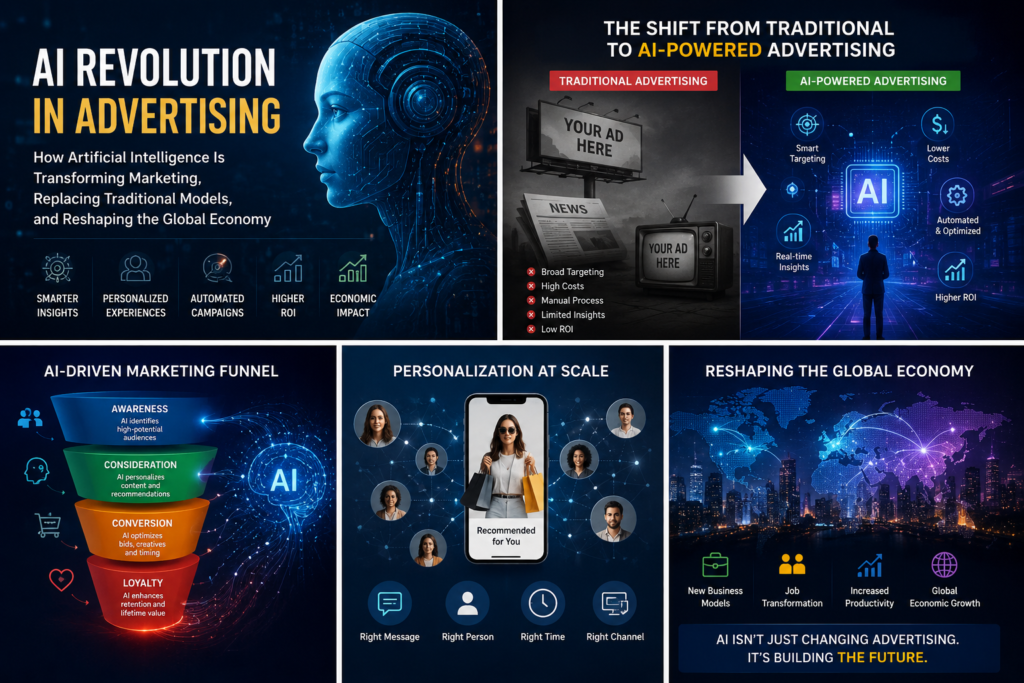
In the bustling boardrooms of Madison Avenue and the algorithm-driven war rooms of Silicon Valley, a quiet yet seismic shift is underway. Artificial intelligence (AI) is not merely augmenting the $1 trillion-plus global advertising industry; it is fundamentally rewriting its rules. From hyper-personalised campaigns generated in seconds to autonomous agents that negotiate media buys and optimise in real-time, AI is replacing decades-old manual processes, creative workflows, and measurement techniques. This transformation promises unprecedented efficiency and ROI but also raises profound questions about jobs, creativity, ethics, and market power.
This article explores the multifaceted ways AI is disrupting traditional advertising, its broader economic and market impacts, and the replacement of legacy models with data-driven, automated systems. Drawing on recent industry reports, expert analyses, and emerging trends as of mid-2026, it paints a complete picture of an industry in flux.
The Traditional Advertising Landscape: A Foundation Under Siege
For much of the 20th and early 21st centuries, advertising operated on predictable models. Agencies crafted campaigns through brainstorming sessions, focus groups, and gut instinct. Media buying involved negotiations with publishers, TV networks, and billboard companies. Targeting relied on broad demographics—age, gender, location—gleaned from surveys and limited data. Measurement was imprecise: TV ratings via Nielsen, print circulation figures, and rudimentary digital click-through rates (CTRs).
Programmatic advertising in the 2010s introduced some automation via real-time bidding (RTB), but it still depended heavily on human oversight for strategy, creative development, and compliance. Budgets were allocated across channels with significant waste—industry estimates have long pegged ineffective ad spend at 30-50% due to poor targeting, fraud, and irrelevance.
Enter generative AI, machine learning (ML), computer vision, and agentic systems. These technologies process vast datasets—consumer behaviour, contextual signals, sentiment, and real-time performance—at speeds and scales impossible for humans. The result? A shift from mass broadcasting to individualised, predictive persuasion.
Core Ways AI is Transforming Creative and Campaign Development
One of the most visible disruptions is in content creation. Tools powered by models like those from OpenAI, Adobe Firefly, and platform-specific solutions (e.g., StackAdapt’s Creative Builder) generate ad copy, images, videos, and even full campaigns from simple prompts. Marketers report producing 50 headlines in the time it once took for one, with AI-generated ads sometimes achieving higher CTRs (0.76% vs. 0.65% for human-made in one multi-university study).
Dynamic Creative Optimisation (DCO) takes this further. AI assembles thousands of ad variants by mixing headlines, visuals, CTAs, and offers tailored to audience segments, contexts, or even individual users. A retailer might show winter coats to cold-weather browsers and swimsuits to others, all in real-time. Case studies show lifts like 60% in CTR for cart abandoners.
Augmented reality (AR) and computer vision enhance this. Brands use AI for virtual try-ons or emotion-detecting ads that adapt based on facial expressions captured via webcams (with privacy safeguards). Predictive analytics forecasts trends, suggesting creatives likely to resonate before launch.
This efficiency democratises high-quality advertising. Small businesses that once relied on generic templates now compete with enterprise-level personalisation, flattening the playing field somewhat—though big tech platforms with proprietary data still hold advantages.
Precision Targeting and Personalisation: Beyond Demographics
Traditional targeting was blunt. AI enables “audience intelligence” through ML models analysing behavioural, contextual, and first-party data. With third-party cookies fading due to privacy regulations (GDPR, CCPA, and beyond), contextual targeting via natural language processing (NLP) has surged. AI reads page content, sentiment, and themes to place ads in relevant environments without tracking individuals.
Personalisation reaches new heights. McKinsey notes that AI-driven segmentation boosts conversions and retention. Brands deliver messages speaking to “mental market share”—the consumer’s mindset at that moment. Predictive models forecast purchase intent, enabling proactive campaigns.
In conversational AI interfaces (chatbots, AI search like ChatGPT or Perplexity), ads integrate directly into dialogues. Spending on LLM advertising is projected to exceed $100 billion globally by 2030. This moves beyond interruption marketing to intent-based commerce.
Automation in Media Buying, Optimisation, and Measurement
Programmatic advertising, already dominant, is becoming fully autonomous. AI handles bidding, pacing, budget allocation, and channel selection. Platforms like Google, Meta, and independents offer “set-it-and-forget-it” campaigns where humans define objectives, and algorithms execute. Meta has discussed fully automating campaigns.
Fraud detection and brand safety improve via ML spotting anomalous traffic or unsafe content. Predictive analytics shifts optimisation from reactive to proactive, forecasting ROAS and recommending adjustments.
Measurement evolves from last-click attribution to multi-touch, incrementality testing powered by AI, providing clearer causality amid fragmented journeys.
Economic Impacts: Efficiency Gains, Job Shifts, and Market Growth
The AI in the advertising market, valued at around $8-14 billion recently, is exploding with CAGRs of 21-28%, potentially reaching $28-80 billion by 2033. Broader digital ad spend hits ~$740 billion in 2026, with AI driving much of the growth.
Efficiency and ROI: Brands report 2x higher ROAS with AI targeting, revenue gains of 6%+ for many teams, and reduced waste. Automation cuts production costs dramatically, allowing reallocation to strategy or new channels. McKinsey and others highlight productivity boosts in content and analytics.
Job Market Transformation: AI is reshaping roles rather than eliminating the industry. Creatives shift from production to curation and strategy. Routine tasks (A/B testing, basic copy) automate, potentially cutting some marketing jobs by significant margins (e.g., 60% in certain forecasts by 2028), but new positions emerge in AI oversight, ethics, and prompt engineering. Agencies refusing to evolve risk obsolescence.
Broader Economy: Lower ad costs improve business margins, especially for SMEs, spurring innovation and competition. However, concentration risks rise as platforms with superior AI (Google, Meta, Amazon) capture more value. Advertising fuels consumer spending; more effective ads could accelerate economic activity in retail, e-commerce, and media. Yet, ad fatigue or distrust from overly personalised or “manipulative” AI (69% of consumers feel manipulated if undisclosed) could dampen effectiveness.
Retail media networks benefit hugely as AI agents influence purchase paths, shifting economics from site attention to distributed commerce. Overall, AI contributes to the $500B+ AI software market growth, with advertising as a key vertical.
How AI Replaces Traditional Models: A Paradigm Shift
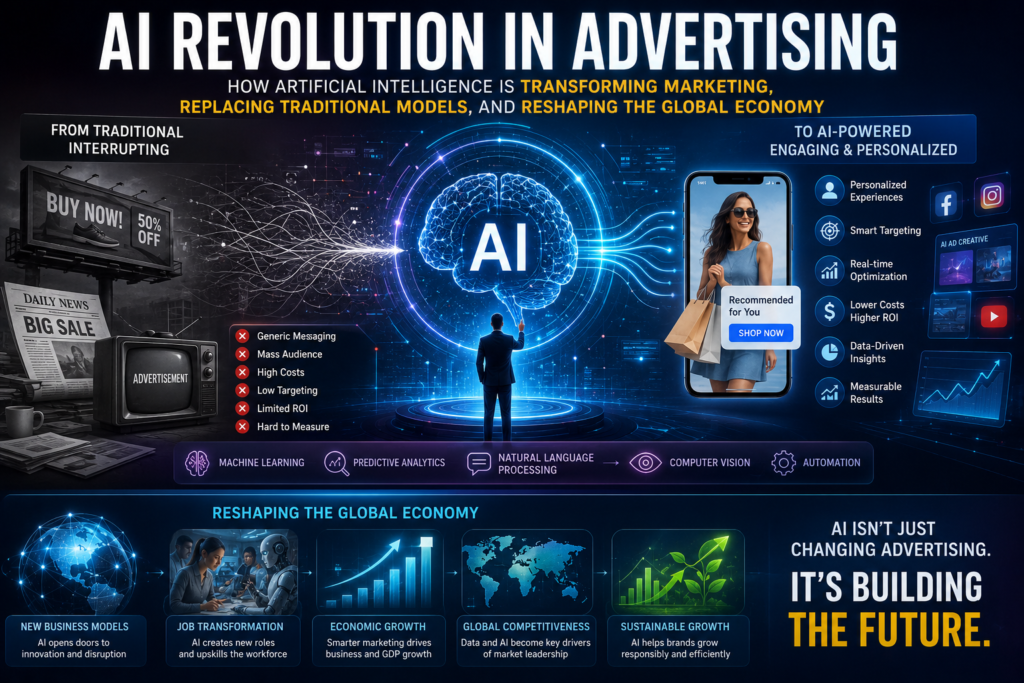
Traditional models were linear: brief → creative → media plan → launch → measure → adjust. AI makes this iterative, predictive, and often agentic.
- From Mass to Micro: Broadcast gives way to 1:1 or segment-of-one marketing.
- Human + Machine Collaboration: AI generates volume; humans provide intuition, ethics, and brand voice. “AI and humans working together” is the mantra.
- New Intermediaries: AI agents and conversational interfaces become the new gatekeepers, potentially reducing traditional ad exposures by 30-47% in discovery/consideration phases but opening direct integration opportunities.
- Data-Driven vs. Instinct: Gut-feel campaigns are replaced by continuous experimentation at scale.
- Emerging Formats: Immersive AR/VR ads, AI-to-AI commerce, and agent-orchestrated campaigns.
Challenges persist: ethical data use, transparency (disclose AI-generated content), bias in algorithms, regulatory hurdles, and the “uncanny valley” where AI ads feel inauthentic and underperform.
Case Studies and Real-World Examples
- Retail/E-commerce: Dynamic ads re-engage users with personalized offers, driving significant revenue shares from minimal budget allocation.
- Global Brands: Coca-Cola, Nike, and others use generative AI for rapid campaign iteration across markets.
- Agencies: Publicis and others invest heavily in AI, viewing it as a “huge transformation.”
- Platforms: StackAdapt, Google, and Meta report efficiency gains, enabling smaller teams to manage larger portfolios.
Future Outlook: 2026 and Beyond
By late 2026 and into 2027, agentic AI—autonomous systems handling end-to-end campaigns—will mature. Expect deeper integration with Web3, metaverses, and voice interfaces. Sustainability (optimising delivery to reduce energy use) and privacy-first approaches will gain prominence.
The industry must balance innovation with responsibility. Marketers adopting AI holistically (creative + media + measurement) see superior results. Training, governance, and human-AI symbiosis will differentiate winners.
Conclusion: A New Creative Economy?
AI is not killing advertising; it is evolving it into a more scientific, scalable, and potentially more human-centric discipline—freeing creatives for big ideas while machines handle the grind. Economically, it promises growth through efficiency and new opportunities, but demands adaptation to avoid disruption. Markets will reward those who master AI as a collaborator, not a crutch.
As one executive noted, the future belongs to marketers who leverage AI to connect more meaningfully. The advertising industry, long a mirror of society and economy, is reflecting a world where intelligence—artificial and human—converges to drive value. The revolution is here; the only question is who will lead it.
==



Leave a Reply