
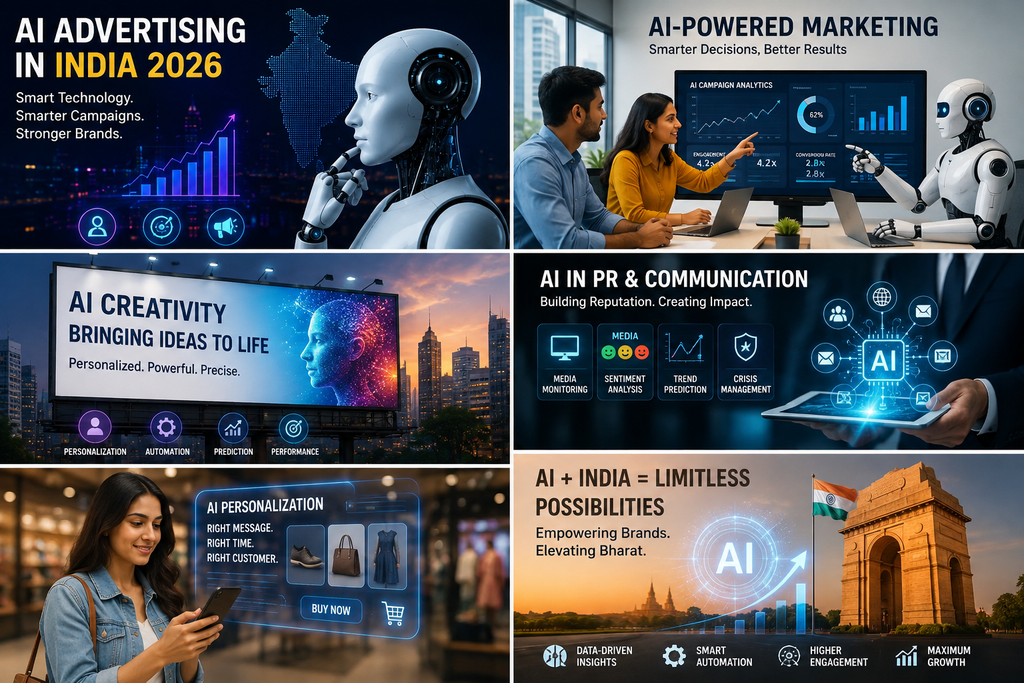
According to multiple industry forecasts released in the first half of 2026, India’s overall advertising market is on track to cross or approach the ₹2 lakh crore mark this year. WPP Media’s This Year, Next Year Midyear 2026 report projects total ad revenue of approximately ₹2 trillion (around $22.5 billion), representing growth of roughly 8.8 per cent. The dentsu-e4m Digital Advertising Report 2026 offers complementary figures, estimating the industry closed 2025 at ₹1,21,339 crore and will reach ₹1,30,416 crore in 2026 before climbing to ₹1,40,001 crore by 2027 at a 7.41 per cent CAGR. Digital continues its march toward dominance: it is expected to account for close to 70 per cent of total ad spend by 2027, with online video projected to capture a 29 per cent share of digital expenditure by the end of 2026.
Within this expanding pie, AI has moved from a supporting technology to a core growth engine. Intelligence advertising — encompassing AI-enabled search, conversational formats and related tools — is forecast to exceed $2.5 billion (roughly ₹22,000 crore) in 2026, growing around 9 per cent. Programmatic buying already accounts for a substantial portion of digital spend and is expected to expand further, powered by AI-led optimisation, first-party data and retail media networks. Retail media itself is one of the fastest-growing segments, with platforms such as Amazon, Flipkart and quick-commerce players like Blinkit, Zepto and Instamart turning shopping environments into high-performance media channels.
From Experimentation to Infrastructure
Industry leaders describe 2026 as the year of applied intelligence. In 2024, marketers largely tested generative tools for copy, images and basic automation. In 2025, those tools moved into daily workflows. By 2026, AI orchestrates planning, creative variation, bidding, measurement and optimisation across search, social, video and commerce in near real time.
Google’s 2026 AI Marketing Blueprint captures the shift clearly: the conversation has moved from “What can AI create?” to “What can AI solve?” Brands are using AI systems to decode consumer intent rather than mere keywords, to generate hyper-personalised content at scale, and to connect discovery with conversion in continuous loops. Case studies illustrate the impact. PolicyBazaar reported 28 per cent incremental policy bookings at 23 per cent lower cost through AI-driven search solutions. Lenovo recorded a 73 per cent increase in purchases and a 53 per cent revenue uplift. Tira Beauty used generative models to overhaul more than 600,000 product titles and descriptions for conversational relevance, achieving a 50 per cent uplift in organic clicks and a 27 per cent rise in conversion value. MakeMyTrip deployed systems that categorised YouTube content in real time and aligned hotel ads with viewer mindset, delivering a 300 per cent jump in conversion rates. AJIO generated over 100 personalised video ads per hour, driving 20 per cent incremental conversions.
These results are not isolated. A BCG survey found India leading global markets in marketing-led AI transformation. Fifty-three per cent of Indian chief marketing officers project 5–9 per cent incremental topline growth from AI — higher than the global average of 43 per cent. Seventy-three per cent rank agentic commerce among their top three priorities, compared with 63 per cent globally. More than half of Indian CMOs fund AI directly from marketing budgets, and many report elevated CEO expectations around digital and AI acceleration.
Adoption statistics reinforce the picture. Studies indicate that 84–92 per cent of Indian marketers are using AI in some form, with particularly strong uptake in content and creative production, measurement and insights, propensity modelling, and customer journey management. Content and creative remain the most mature use cases; many teams report high business impact from AI-assisted ad creation, video editing, multilingual copy and rapid variation. Yet maturity remains uneven. While a significant share of large brands already influence 40–60 per cent of digital media spend through AI or algorithmic layers, experts project that figure could reach 70–80 per cent for digitally mature advertisers by FY27. Many organisations still rely on fragmented tools and external partners rather than fully integrated stacks, and only a minority have comprehensive AI guidelines or in-house capability at scale.
Creative Production Reimagined
Nowhere is the transformation more visible than in creative production. Campaign turnaround times have collapsed, and costs have fallen dramatically. Reports cite reductions of up to 70 per cent in campaign timelines and 85 per cent in certain production costs for AI-assisted work. Teams that once required dozens or hundreds of people for a major film can now deliver cinematic output with small specialised units.
Several high-profile campaigns illustrate the new normal. Emami’s Dermicool produced what was described as India’s first fully AI-generated FMCG ad film — a sci-fi narrative of “Ghamoriyas” and Neem-Tulsi warriors that retained the classic jingle while reimagining the visual world. Reliance SMART Bazaar, working with Sixteen By Nine Media, created 64 distinct ad films across eight concepts, four languages (Hindi, Tamil, Telugu, Kannada) and two formats in under seven days. Tata Gluco+ launched a 100 per cent AI television commercial. AJIO used generative tools to produce its All Stars Sale campaign, generating thousands of images and hundreds of video clips. Star Health introduced AI-generated films for the insurance category. Mondelez India scaled personalised Cadbury Silk videos into hundreds of thousands of unique pieces. Smaller and mid-sized brands have followed, using AI for regional language adaptation, rapid testing and previously impossible visual concepts.
Agencies and in-house teams report that AI is expanding rather than replacing human creativity. Tools generate variations, storyboards, prototypes and multilingual adaptations at speed, freeing strategists and creatives to focus on insight, cultural nuance and brand narrative. New roles have emerged: AI strategists, prompt architects, data linguists and automation leads. At the same time, global capability centres in India are enabling multinational brands to bring more creative work in-house. Companies such as Kimberly-Clark have reduced content creation cycles from nearly a month to a matter of hours using India-based AI platforms.
Vernacular capability has become a strategic differentiator. Studies show vernacular content delivers 30–40 per cent higher engagement than English-only communication. AI’s ability to generate and localise high-quality content across Indian languages at scale is closing a long-standing gap between national campaigns and regional relevance.
Media Buying, Targeting and Measurement
On the media side, AI has accelerated the shift toward performance and efficiency. Programmatic buying continues to gain share, supported by AI optimisation, first-party data strategies and the rise of retail media. Social media and online video remain the largest absolute engines of digital growth, fuelled by short-form formats, creator ecosystems and social commerce. Commerce-related advertising is among the fastest-growing segments, projected to expand strongly as marketplaces and quick-commerce platforms integrate advertising deeper into the purchase journey.
Hyper-personalisation has emerged as a dominant theme. Indian consumers show high openness to AI-driven recommendations even as foundational awareness of the technology remains limited in some segments. Brands that successfully combine first-party data, real-time signals and generative creative are achieving measurable lifts in conversion and efficiency. Predictive moment marketing — using machine learning to forecast trends and pre-position content — is moving from reactive social listening to proactive opportunity capture.
Measurement is also evolving. Attribution, incrementality testing and unified reporting are increasingly AI-supported. The challenge for many marketers is moving from fragmented dashboards to coherent systems that connect upper-funnel brand activity with lower-funnel performance across an expanding set of channels.
Public Relations and Reputation in the Age of AI
The transformation is equally profound in public relations and corporate communications. India’s PR industry grew 11 per cent in FY26 to ₹3,230 crore, according to the PRCAI SPRINT 2026 report, and is projected to reach ₹4,500 crore by 2030. AI investment as a share of industry revenue has risen from 2 per cent three years ago to 7 per cent in FY26, with expectations of further increase.
PR firms are deploying AI across research and intelligence gathering, written content creation, meeting summarisation, visual ideation, content versioning and stakeholder mapping. The technology improves speed and scale, yet practitioners emphasise that it complements rather than replaces strategic counsel. In an environment saturated with AI-generated content, credibility and earned media have gained renewed importance. Large language models increasingly surface third-party, authoritative sources, making quality journalism and authentic influencer relationships more valuable for brand discovery and reputation.
At the same time, new risks have materialised. Corporate communicators report a rise in fake-news incidents and flag AI-generated misinformation and deepfakes as top reputational threats. Agencies and brands are investing in detection capabilities, verification protocols and ethical frameworks. The industry narrative has shifted toward reputation as a business driver rather than a soft add-on, with greater demand for integrated services spanning digital communications, influencer engagement, crisis advisory, public policy and analytics-led strategy. Client composition is also changing: start-ups now represent a significantly larger share of PR spending, alongside education, ed-tech and FMCG brands, while government work has grown.
Structural Shifts and Competitive Dynamics
Several structural forces are amplifying AI’s impact. India’s large and growing digital consumer base, rapid mobile adoption, expanding 5G footprint and vibrant creator economy provide fertile ground. The country’s engineering talent pool, global capability centres and rising AdTech product companies position it as a potential global hub for AI-led advertising infrastructure. Firms such as InMobi and Affle already operate as global product businesses. Redseer Strategy Consultants and others note that India is moving beyond pure services toward product and engineering leadership in the AI-AdTech space.
Agency models are adapting. Consolidation has created larger entities with greater scale and data resources. In-house capabilities are expanding as brands seek speed and control. Traditional agencies that differentiate solely on size face pressure; those that combine strategic insight, cultural fluency and AI orchestration are better positioned. Cost structures are changing: AI reduces certain production and planning expenses while creating new investment requirements in talent, tools, data infrastructure and governance.
Regulatory and ethical considerations are rising in parallel. Privacy frameworks, including the Digital Personal Data Protection Act, influence data strategies. Concerns around copyright, deepfakes, bias in models and the authenticity of AI-generated content are prompting brands and agencies to develop clearer policies. Consumer trust remains high relative to some global benchmarks, yet sustaining it will require transparency and responsible practice.
Challenges and the Road Ahead
Despite rapid progress, significant hurdles remain. AI maturity is uneven across organisations and agency sizes. Skills gaps, budget constraints for smaller players, and the complexity of integrating tools into coherent systems limit full value realisation. Many marketers still operate with standalone solutions rather than end-to-end platforms. Measurement of AI’s incremental contribution can be difficult when tools are layered across multiple vendors. Cultural and creative authenticity must be protected even as production scales. And the risk of homogenised or low-quality output exists if human oversight and strategic judgement are diluted.
Looking forward, 2026 is widely viewed as an integration year. Scale meets responsibility, data meets creativity, and growth demands coherence. Agentic systems that can plan, execute and optimise multi-channel campaigns with limited human intervention are moving from concept toward practical deployment. Conversational and AI-native advertising formats are expected to close the adoption gap with more mature markets more quickly than previous technology waves. Retail media, short-form video, vernacular content and commerce-linked experiences will continue to drive volume. Brands that embed AI across the stack, build robust first-party data capabilities, maintain human creative and ethical guardrails, and treat reputation as a core growth asset are positioned to capture disproportionate value.
India’s advertising market has long been characterised by its complexity — linguistic diversity, vast socioeconomic range, rapid digital leapfrogging and intense competition for attention. Artificial intelligence is not simplifying that complexity so much as making it manageable at unprecedented scale and speed. The brands and agencies that master the combination of algorithmic precision and human insight will define the next decade of marketing, PR and brand growth in one of the world’s most dynamic consumer markets.
The transformation is no longer prospective. In 2026, it is already rewriting the rules of how brands are built, how messages are crafted and delivered, how relationships with consumers and stakeholders are managed, and how growth is measured and achieved. The winners will be those who treat AI not as a novelty or a cost-cutting device, but as the new foundation of competitive advantage.



Leave a Reply