
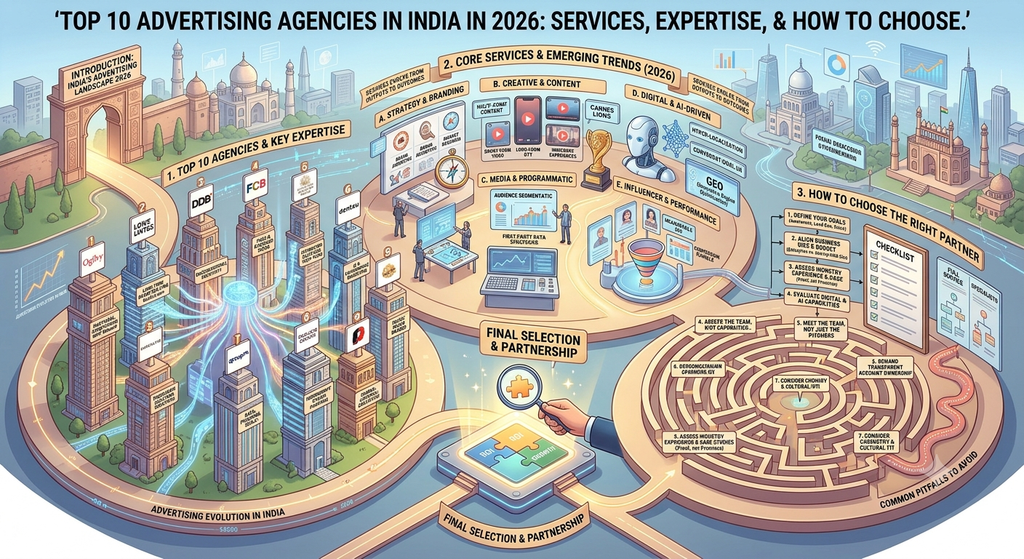
Against this backdrop of structural change, AI-assisted production, retail media growth, connected TV expansion and the enduring importance of emotional storytelling in a diverse market, the question for marketers remains practical: which agencies deliver the right mix of creative excellence, media muscle, digital performance and cultural fluency? This report profiles ten of the most prominent advertising agencies operating in India in 2026, drawing on industry rankings, award performances, client work, and market commentary. It is not a rigid revenue ranking—public agency-level financials remain limited—but a synthesis of consistent visibility, creative and media recognition, and operational scale. The list mixes network powerhouses with standout independents.
1. Ogilvy India (WPP)
Ogilvy India retains its reputation as one of the country’s most admired creative networks. With offices spanning Mumbai, Bengaluru, Gurgaon, Hyderabad, Kolkata and Coimbatore, it offers one of the widest geographic footprints among global networks in India.
Services and expertise: Full-service creative strategy, brand building, integrated campaigns across television, digital, social and experiential, public relations, and healthcare communications. The agency is particularly strong in long-running brand platforms and culturally resonant storytelling. Clients have historically included major FMCG, automotive, technology and financial services brands. Recent recognition includes multiple winning campaigns at the IndIAA Awards.
Why it stands out: Deep consumer insight capability, a track record of both award-winning work and business results, and the ability to operate at national scale while maintaining creative quality. Ideal for large national brands seeking sustained brand equity alongside campaign execution.
2. Dentsu India (Dentsu Group)
Dentsu operates as an umbrella in India covering creative (including the strong digital-creative heritage of Webchutney), media (Carat and others), performance (iProspect) and data/CRM capabilities (Merkle). It is frequently cited among the top integrated players.
Services and expertise: Integrated creative and digital campaigns, performance marketing, media planning and buying, CRM and customer experience, and technology-enabled solutions. Strengths lie in mobile-first and data-backed storytelling suited to younger audiences and performance-oriented categories.
Why it stands out: Breadth of specialised units under one group roof allows clients to access creative, media and performance without fragmenting relationships. Competitive for brands that want digital and performance depth alongside traditional brand work.
3. McCann Worldgroup India (Omnicom)
McCann maintains a multi-city presence (Mumbai, Gurugram, Bengaluru, Chennai) and is recognised for insightful, culturally relevant brand communications. Post-Omnicom–IPG integration, it forms part of a larger creative and media portfolio.
Services and expertise: Brand strategy, creative campaigns, integrated marketing communications, and work that often emphasises emotional and cultural insight. The network has a history of strong award performances and work for major Indian and multinational clients.
Why it stands out: Ability to blend global network resources with local cultural fluency. Suitable for brands seeking distinctive creative platforms that travel across media.
4. Leo India (formerly Leo Burnett, Publicis Groupe)
Publicis has streamlined the Leo Burnett identity in India as part of broader network rationalisation, yet the agency continues to be associated with strong creative output and human-centric storytelling.
Services and expertise: Emotion-driven creative campaigns, brand platforms, OTT and digital content, and outreach that often includes rural or mass-market India. The “Humankind” philosophy remains a reference point for consumer-centric work.
Why it stands out: Proven ability to create memorable, high-emotion work that builds long-term brand affinity. Attractive to marketers prioritising brand love and cultural relevance over pure short-term performance metrics.
5. TBWA\Lintas (Omnicom)
One of the clearest outcomes of the 2026 Omnicom–IPG consolidation has been the revival and positioning of the Lintas heritage under the TBWA network. The agency carries significant Indian advertising history while operating within a modern global creative network.
Services and expertise: Creative strategy, brand communications, integrated campaigns, and work that draws on both disruption-oriented TBWA thinking and deep Indian market experience.
Why it stands out: Combination of a powerful local legacy brand with global network resources and the scale advantages of the expanded Omnicom Advertising India portfolio. Relevant for clients who value both heritage and contemporary creative ambition.
6. Schbang (Independent)
Schbang has emerged as one of the most visible and talked-about independent agencies, operating with creative, media and technology capabilities under one roof, primarily out of Mumbai.
Services and expertise: Integrated creative and digital work, social and content-led campaigns, media, and technology solutions. Strong presence with startups, fintech, beauty and digitally native brands, while also serving larger clients seeking agility.
Why it stands out: Speed of decision-making, willingness to take creative risks, and an integrated model that reduces the coordination friction common in pure network setups. Particularly suitable for mid-to-large brands that want senior attention and a single accountable partner rather than pure holding-company scale.
7. Grey India (WPP)
Grey positions itself around “Famously Effective” work and maintains offices in Mumbai, Bengaluru and Delhi. It sits within the WPP ecosystem alongside creative and media sister agencies.
Services and expertise: Brand campaigns focused on effectiveness, creative development for large global and Indian brands, and integration with broader WPP resources when required.
Why it stands out: Emphasis on work that delivers measurable business outcomes alongside creative quality. A solid choice for marketers who want network scale with a clear effectiveness orientation.
8. Havas Village India (Havas)
Havas operates an integrated “Village” model that brings creative, media and production capabilities closer together under one roof, primarily from Mumbai.
Services and expertise: Integrated campaigns spanning creative, media planning/buying and production. The model aims to reduce silos and accelerate collaboration.
Why it stands out: Structural integration can deliver faster turnaround and tighter alignment between idea and media execution. Attractive to clients seeking fewer hand-offs between specialised units.
9. Interactive Avenues (Omnicom / former IPG)
Interactive Avenues describes itself as India’s largest full-service digital agency, with a presence in Mumbai, Gurugram, Bengaluru, Kolkata and Chennai. It has long been a major player in digital media and performance.
Services and expertise: Full-service digital marketing, media planning and buying (especially digital and performance), creative for digital platforms, and large-scale campaign management.
Why it stands out: Scale and specialisation in the digital and performance space. Well suited to brands with significant digital budgets or those prioritising measurable online outcomes alongside brand work.
10. Famous Innovations (Independent)
Famous Innovations is frequently cited among the leading independents for culture-led, innovation-focused creative work, with offices in Mumbai, Bengaluru, Delhi and Lucknow.
Services and expertise: Creative strategy and campaigns that emphasise cultural relevance, innovation and distinctive brand expression. Strong independent ethos with multi-city reach.
Why it stands out: Ability to deliver high-creativity work with senior involvement and cultural sharpness. A compelling option for brands that prioritise distinctive creative platforms and are comfortable with an independent rather than network structure.
Honourable mentions include Madison World (strong independent media presence), Talented (Bengaluru-based creative agency founded by former digital-creative leadership), and various specialised digital and performance shops that dominate narrower categories.
Industry Context in 2026
Several structural realities shape agency choice this year. First, holding-company consolidation has increased the importance of understanding which specific agency brand and team will handle the work, not merely the group name. Second, media agency performance remains highly competitive: Mindshare led the EMVIES 2026 Best Media Agency ranking, with Wavemaker close behind, while WPP Media dominated network points. Third, digital continues its rise; estimates place digital ad spend well above ₹70,000 crore in 2025, with continued double-digit growth expected. Fourth, AI tools are moving from experimentation into production workflows, raising questions about how agencies will blend human creativity with machine efficiency and how they will price and govern AI-generated assets.
Large national advertisers with complex multi-channel needs still gravitate toward network agencies for scale, buying power and multi-city execution. Mid-sized and digitally native brands increasingly favour independents or specialist digital agencies for speed, senior access and cultural fluency.
How to Choose the Right Advertising Agency in 2026
Selecting an agency is less about chasing the “top” name and more about matching capability, culture and commercial reality to specific business needs. A practical framework includes the following steps.
1. Clarify objectives and success metrics first.
Define whether the priority is brand building, short-term sales or performance, category disruption, regional expansion, or a combination. Translate goals into measurable outcomes (brand metrics, ROAS, share of voice, pipeline contribution, etc.). Agencies that can discuss success in business terms rather than only awards or vanity metrics are usually stronger partners.
2. Match agency type to need.
- Full-service network agencies suit large, multi-channel national campaigns requiring media scale and multi-city coordination.
- Integrated independents such as Schbang or Famous Innovations often deliver faster decisions and higher senior involvement for mid-to-large brands.
- Specialised digital or performance agencies are preferable when the bulk of spend and attention sits in paid search, social, programmatic or e-commerce.
- Pure creative boutiques can excel at platform development but may require separate media partners.
3. Demand relevant proof, not just logos.
Request case studies from comparable categories, business models or growth stages. Look for starting baselines, strategy, execution details and quantified outcomes. Award wins are useful signals of craft but should be weighed against commercial results.
4. Meet the actual team.
Pitch teams and delivery teams frequently differ. Ask who will lead strategy, creative and day-to-day account management. Assess cultural fit, communication style and willingness to push back constructively.
5. Examine process, measurement and ownership.
Clarify briefing-to-launch timelines, iteration loops, reporting cadence and the metrics that will be tracked. Ensure the client retains ownership of ad accounts, data and creative assets. Transparent separation of agency fees from media spend is essential.
6. Evaluate AI and technology maturity realistically.
Ask how the agency uses AI in research, content production, media optimisation and measurement, and what human oversight remains. Avoid agencies that either over-promise automation or ignore AI entirely.
7. Assess commercial terms and risk.
Compare retainers, project fees and performance-linked elements. Understand exit clauses, notice periods and transition support. Realistic agencies set clear expectations rather than guaranteeing specific results.
8. Consider geography and language.
For campaigns with strong regional or vernacular components, multi-city networks or agencies with demonstrated regional strength reduce friction. Independents with distributed offices can also serve this need effectively.
Red flags include guaranteed rankings or ROAS figures, vague case studies without numbers, reluctance to name the working team, opaque pricing, or pressure to move media accounts into agency-controlled setups without clear justification.
Looking Ahead
India’s advertising market in 2026 rewards agencies that can combine cultural insight with data discipline, creative ambition with commercial accountability, and human craft with intelligent use of technology. The top network agencies continue to dominate large-scale national work and media investment, while the strongest independents are winning share through speed, integration and senior attention. Marketers who begin with clear objectives, insist on relevant evidence, and evaluate cultural and operational fit carefully will find capable partners across both segments.
The agencies profiled above represent a cross-section of the capability currently available. The optimal choice depends less on any universal ranking and more on the specific problem a brand needs to solve in the year ahead.


Leave a Reply