
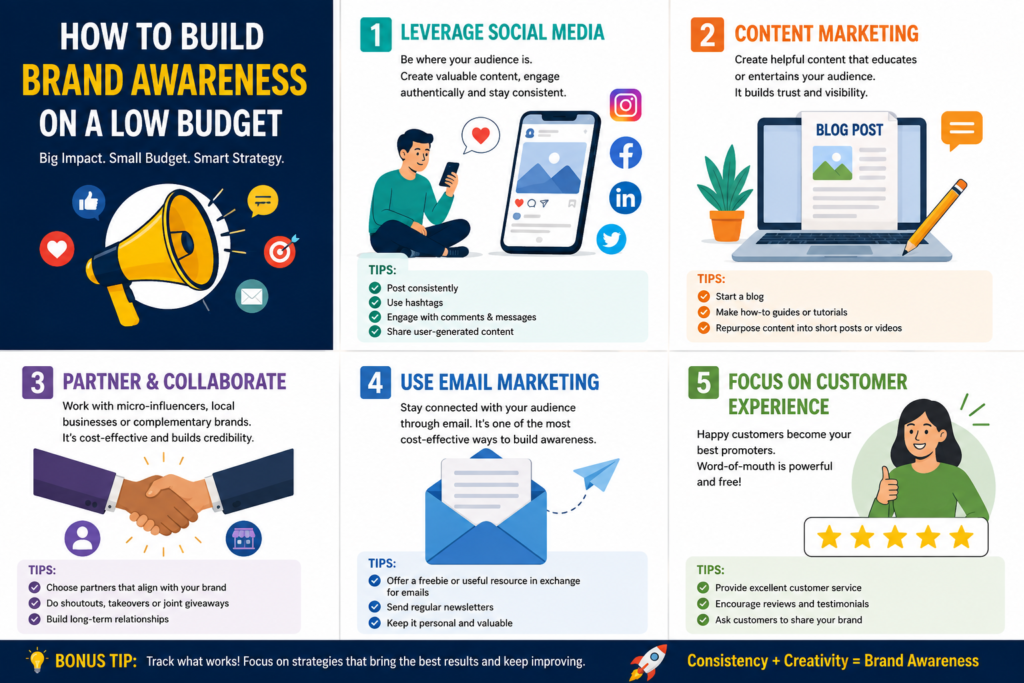
Brand Awareness Is No Longer Reserved for Companies With Huge Advertising Budgets
The marketing landscape in 2026, however, is significantly different.
The growth of social media, search engines, artificial intelligence, digital public relations, content marketing and online communities has made it possible for small businesses to reach large audiences without spending enormous amounts of money.
A local business with a strong message, useful content and a consistent digital presence can now compete for attention with companies that have much larger marketing budgets.
But low-budget marketing does not mean random marketing.
The most successful brands understand that awareness is built through consistency, trust, recognition and repeated exposure. A business does not necessarily need to be everywhere. Instead, it needs to be visible to the right people in the right places.
For startups, small businesses, entrepreneurs and growing brands, the challenge in 2026 is not simply how much money they can spend. The bigger question is how intelligently they can use the money, time and resources available to them.
This report examines practical and affordable strategies for building brand awareness on a low budget and explains how businesses can use content, public relations, social media, search visibility, partnerships and artificial intelligence to create stronger brand recognition.
What Is Brand Awareness and Why Does It Matter?
Brand awareness refers to how familiar people are with a business, its name, products, services, values and visual identity.
When consumers repeatedly see a brand, remember its name and associate it with a particular product or benefit, the company has successfully built awareness.
For example, a person may not immediately need a company’s product. However, if they regularly encounter the company’s content, social media posts, articles or advertisements, they are more likely to remember the brand when they eventually need that product or service.
Brand awareness can influence several important business outcomes, including:
- Customer trust
- Website traffic
- Search interest
- Social media engagement
- Lead generation
- Sales
- Customer loyalty
- Word-of-mouth marketing
People generally feel more comfortable buying from brands they recognise.
This is why awareness should not be viewed only as a marketing vanity metric. It is often the foundation of future sales.
A small company may not have the budget to immediately compete for every customer through paid advertising. But it can gradually become recognisable within a specific industry, city, customer group or online community.
Over time, recognition can become a competitive advantage.
1. Start With a Clear Brand Identity
One of the cheapest and most effective ways to build awareness is to create a clear and consistent brand identity.
Many small businesses make the mistake of frequently changing their logo, colours, messaging, slogans and social media style. This can make it difficult for audiences to remember who they are.
A strong brand identity should answer several questions.
What does the company do?
The business should be able to explain its services in a simple sentence.
Who is the target audience?
A company should understand whether it is targeting students, professionals, businesses, consumers, local customers or a particular industry.
What makes the brand different?
The answer does not always need to be revolutionary. It could be better service, affordable pricing, faster delivery, specialist knowledge or a unique approach.
What should people remember?
The brand should aim to create one or two strong associations in the minds of customers.
For example, a company might want to be known for affordable advertising, reliable technology, expert financial information or high-quality customer service.
Consistency is important.
The same business name, logo, colours, tone and core message should appear across the website, social media profiles, business listings, email communication and marketing materials.
A consistent brand is easier to recognise.
2. Create a Simple but Professional Digital Home
A website remains one of the most important assets for building brand awareness.
Social media platforms are valuable, but businesses do not fully control them. Algorithms can change, reach can decline, and accounts can face restrictions.
A professional website provides a central location where customers can learn about the brand.
For businesses operating on a limited budget, the website does not need to be extremely complicated.
It should clearly communicate:
- Who the company is
- What products or services it provides
- Who it serves
- Why customers should choose it
- How people can contact the business
The website should also include clear branding.
A visitor should quickly understand the company’s name, purpose and value.
Businesses can gradually expand their website by adding:
- Articles
- Industry guides
- News updates
- Case studies
- Frequently asked questions
- Customer testimonials
- Service pages
- Videos
Every useful page becomes another opportunity for people to discover the brand through search engines and shared links.
3. Use Content Marketing Instead of Expensive Advertising
Content marketing is one of the strongest low-budget strategies available to businesses.
Instead of constantly paying for advertisements, companies can create useful content that continues attracting readers and potential customers over time.
A single high-quality article can potentially generate traffic for months or years.
Useful content can include:
- Industry news
- How-to guides
- Product comparisons
- Expert analysis
- Frequently asked questions
- Checklists
- Research reports
- Case studies
- Trend reports
The most effective content usually solves a problem.
For example, instead of publishing only promotional content such as “Buy Our Services,” a business can create content around questions customers are already asking.
A digital marketing company could publish articles such as:
- How to advertise a small business on a low budget
- Best digital marketing strategies for startups
- How to increase local business visibility
- How artificial intelligence is changing advertising
- How companies can improve online reputation
This approach helps position the company as a useful source of information rather than simply another advertiser.
Over time, readers may begin associating the brand with expertise.
That association is extremely valuable.
4. Focus on Search Engine Visibility
Search traffic is particularly important for businesses with limited advertising budgets because organic visibility can continue generating visitors without requiring payment for every click.
Search engine optimisation should therefore become part of the long-term brand awareness strategy.
Companies should identify topics that potential customers are actively searching for.
For example, a business serving startups may research topics such as:
- Affordable advertising
- Startup marketing
- Public relations services
- Brand awareness strategies
- Social media marketing
- AI marketing tools
The company can then create detailed, useful pages around these subjects.
However, businesses should avoid producing large volumes of low-quality content simply to attract search traffic.
Search visibility increasingly depends on usefulness, originality, relevance and trust.
A strong strategy is to create fewer but more valuable articles.
Each article should have:
- A clear headline
- Useful information
- Easy-to-read structure
- Relevant keywords used naturally
- Original analysis or insights
- Accurate information
- Internal links to relevant pages
Search optimisation and brand awareness can work together.
When readers repeatedly encounter a company’s articles while searching for industry information, the business becomes increasingly familiar.
5. Build a Strong Presence on One or Two Social Platforms First
A common mistake among small businesses is attempting to dominate every social media platform simultaneously.
This can lead to inconsistent posting and poor-quality content.
A more efficient strategy is to identify the platforms where the target audience is most active.
A business targeting professionals may focus on professional networks and business-oriented content.
A consumer brand may benefit from highly visual social platforms.
A company serving local customers may benefit from location-based communities and business listings.
The goal is not simply to collect followers.
The goal is to become recognisable.
Businesses should develop a consistent content style. This could include recurring formats such as:
- Daily industry tips
- Weekly news summaries
- Short educational videos
- Customer success stories
- Behind-the-scenes posts
- Expert opinions
- Market updates
- Frequently asked questions
Repetition helps create familiarity.
A small company that publishes useful content consistently may eventually build stronger engagement than a larger company that only posts occasionally.
6. Turn Employees and Founders Into Brand Ambassadors
One of the most underused low-budget marketing resources is the people already connected to the company.
Founders, employees, experts and team members can all contribute to brand awareness.
People often connect more easily with people than with corporate logos.
A founder who regularly shares useful insights can help establish the company’s credibility.
Employees can also contribute by sharing:
- Professional experiences
- Industry observations
- Educational content
- Company achievements
- Behind-the-scenes stories
This does not mean employees should be forced to become influencers.
Instead, companies can encourage authentic participation from team members who are comfortable sharing their knowledge.
A small organisation can significantly expand its reach when several people contribute to building the brand’s visibility.
7. Use Public Relations as a Low-Cost Awareness Strategy
Public relations can be a powerful alternative to expensive advertising.
A company does not necessarily need a massive PR budget to receive media attention.
Journalists, bloggers and industry publications are often interested in:
- New business trends
- Research findings
- Industry data
- Expert opinions
- Innovative products
- Startup stories
- Local business developments
- Technology developments
Instead of sending promotional messages, businesses should look for genuinely newsworthy stories.
For example, a company could publish original research about consumer behaviour in its industry.
It could release a report highlighting emerging trends.
It could provide expert commentary on a major industry development.
The more useful and relevant the information is, the more likely it may be to attract attention.
Digital PR can also help create valuable online mentions.
When respected publications discuss a business or its experts, the brand may benefit from increased credibility and awareness.
8. Partner With Other Small Businesses
Partnership marketing can allow companies to reach new audiences without paying for expensive advertising campaigns.
Businesses should identify organisations serving similar audiences but offering different products.
For example, an advertising company could partner with:
- Web development agencies
- Graphic design companies
- Business consultants
- Startup communities
- Event organizers
The partners can collaborate on:
- Webinars
- Guides
- Events
- Social media campaigns
- Newsletters
- Research reports
A partnership allows both organisations to share audiences.
For small companies, this can be significantly more affordable than attempting to build every audience independently.
The key is to find partnerships where both sides receive value.
9. Encourage Customer Reviews and Word-of-Mouth Marketing
Word-of-mouth remains one of the most powerful forms of brand awareness.
People often trust recommendations from customers more than direct promotional claims from companies.
Businesses should therefore make it easy for satisfied customers to share their experiences.
This can include encouraging customers to leave reviews or testimonials.
However, companies should avoid fake reviews or misleading promotional tactics.
Authenticity is essential.
A small number of detailed and genuine testimonials can sometimes be more effective than a large number of generic comments.
Businesses can also transform positive customer experiences into case studies.
A case study can explain:
- The customer’s problem
- The solution provided
- The results achieved
- The lessons learned
This creates useful content while also demonstrating the company’s capabilities.
10. Create Shareable Content
Some of the most effective low-budget marketing campaigns succeed because people voluntarily share the content.
Businesses should therefore think about what audiences might find useful enough to share.
Shareable content often includes:
- Useful statistics
- Infographics
- Industry reports
- Checklists
- Templates
- Educational guides
- Short videos
- Trend analysis
A company does not need every post to become viral.
Even highly targeted content can produce significant results if it reaches the right audience.
For example, a detailed guide shared among professionals in a particular industry may generate more valuable awareness than a viral entertainment post that attracts people with no interest in the business.
The quality of attention is often more important than the quantity.
11. Use Artificial Intelligence to Reduce Marketing Costs
Artificial intelligence is becoming an increasingly important tool for small businesses attempting to compete with larger organisations.
AI can help companies improve efficiency in several areas.
It can assist with:
- Content ideas
- Article outlines
- Social media planning
- Headline development
- Keyword research
- Marketing analysis
- Email drafting
- Content repurposing
For example, a business may create one detailed article and then adapt its main points into multiple social media posts, short videos, newsletters and graphics.
This approach can significantly increase the value of each piece of content.
However, businesses should avoid relying entirely on automatically generated material.
Brand awareness depends on trust.
Generic content may fail to create a distinctive brand identity.
Companies should use AI to improve productivity while maintaining human expertise, original ideas and editorial quality.
12. Repurpose Every Major Piece of Content
Small businesses often have limited resources, which means content should be used more than once.
A single research article can become:
- A blog post
- Several social media posts
- A short video
- An infographic
- A newsletter
- A presentation
- A downloadable guide
This strategy is known as content repurposing.
It allows businesses to remain visible across multiple channels without constantly starting from zero.
For example, a company might publish a detailed report on the future of advertising.
The report could then be divided into:
- Five social media posts
- Ten short tips
- One infographic
- One video
- One email newsletter
The original research becomes the foundation for an entire awareness campaign.
This is particularly valuable for companies working with limited marketing teams.
13. Become Useful Within a Specific Community
Small businesses do not always need to target the entire world.
In many cases, becoming well known within a specific community can be more valuable.
That community might be based on:
- A city
- An industry
- A profession
- A customer interest
- A business sector
Companies can build recognition by regularly contributing useful information and participating in relevant discussions.
The goal should not be aggressive promotion.
Instead, businesses should focus on being genuinely helpful.
A company that consistently provides useful answers may gradually become recognised as a trusted participant within a community.
Trust can eventually lead to referrals, partnerships and customers.
14. Build an Email Audience
Email remains an important tool because businesses can communicate directly with people who have already shown interest.
A company can encourage website visitors to subscribe by offering useful information such as:
- Weekly industry updates
- Free guides
- Trend reports
- Business tips
- Special offers
The objective should not be to send constant promotional messages.
A useful newsletter can strengthen the relationship between a brand and its audience.
Repeated communication also increases familiarity.
Over time, subscribers may become customers or recommend the brand to others.
15. Measure What Is Actually Working
Low-budget businesses cannot afford to waste resources.
Marketing decisions should therefore be based on results rather than assumptions.
Companies should regularly monitor:
- Website traffic
- Search impressions
- Brand searches
- Social media engagement
- Referral traffic
- Email subscriptions
- Leads
- Sales inquiries
The purpose is not to become obsessed with every number.
Instead, businesses should identify which activities are producing meaningful results.
If one type of content consistently attracts visitors, the company may consider producing more content around that topic.
If a social platform produces no meaningful engagement after a reasonable period, resources may be redirected elsewhere.
Low-budget marketing requires continuous improvement.
A Practical 90-Day Low-Budget Brand Awareness Plan
Businesses can begin with a simple three-month strategy.
Month One: Build the Foundation
During the first month, businesses should focus on improving their identity and digital presence.
Key tasks include:
- Clarifying the brand message
- Updating the website
- Improving social media profiles
- Identifying target audiences
- Researching important industry topics
- Creating a basic content calendar
The objective is consistency.
Month Two: Increase Visibility
During the second month, the business should begin publishing and promoting useful content.
Activities may include:
- Publishing detailed articles
- Posting regularly on selected social platforms
- Creating short videos
- Reaching out to industry communities
- Beginning partnership discussions
- Collecting customer testimonials
The goal is to increase the number of places where potential customers can encounter the brand.
Month Three: Build Authority
The third month should focus on credibility.
Businesses can:
- Publish original research
- Release an industry report.
- Share expert commentary
- Create case studies
- Contact relevant publications
- Develop partnerships
- Improve high-performing content
By the end of the 90-day period, the company should have a stronger foundation of content, visibility and brand assets.
Common Mistakes Small Businesses Should Avoid
While trying to build awareness, companies should avoid several common mistakes.
Trying to reach everyone
A clear target audience is more valuable than vague mass marketing.
Posting inconsistently
Brand recognition requires repeated exposure.
Copying competitors
Competitor research is useful, but companies need their own voice and identity.
Focusing only on sales
Awareness is built through useful and memorable experiences.
Ignoring customer experience
A strong marketing campaign cannot compensate for consistently poor service.
Chasing every trend
Not every viral topic is relevant to the brand.
Expecting immediate results
Organic brand awareness usually takes time.
The Future of Low-Budget Brand Building
The future of marketing is likely to become increasingly competitive.
Artificial intelligence is making content production faster and easier, meaning audiences may encounter more marketing material than ever before.
As content volumes increase, originality and trust may become even more valuable.
Businesses that simply produce large amounts of generic content may struggle to stand out.
Companies that combine technology with genuine expertise, useful information and strong relationships may have a greater opportunity to build lasting brands.
The brands that succeed will not necessarily be those spending the most money.
They may instead be the companies that understand their audiences, communicate clearly and consistently provide value.
Conclusion
Building brand awareness on a low budget is not easy, but it is more achievable than ever.
Small businesses now have access to tools that were once available primarily to large corporations. Websites, search engines, social media, digital public relations, email marketing and artificial intelligence have created new opportunities for companies to build recognition without massive advertising budgets.
The most important investment is often consistency.
A company should develop a clear identity, understand its audience and repeatedly provide useful content and experiences.
Instead of spending heavily on short-term visibility, businesses can gradually build long-term assets.
A useful article can continue attracting readers.
A strong customer experience can generate referrals.
A partnership can introduce the company to a new audience.
An expert opinion can create media visibility.
A consistent social media presence can make a brand increasingly recognisable.
For small businesses in 2026, brand awareness is no longer simply a question of who has the largest advertising budget.
It is increasingly a question of who can create the most value, build the most trust and remain consistently visible.
A limited budget may slow growth, but it does not prevent a business from becoming a recognised brand.
With a focused strategy, useful content, intelligent use of technology and a commitment to consistency, even a small company can build awareness that eventually translates into stronger traffic, greater trust and sustainable business growth.




Leave a Reply