
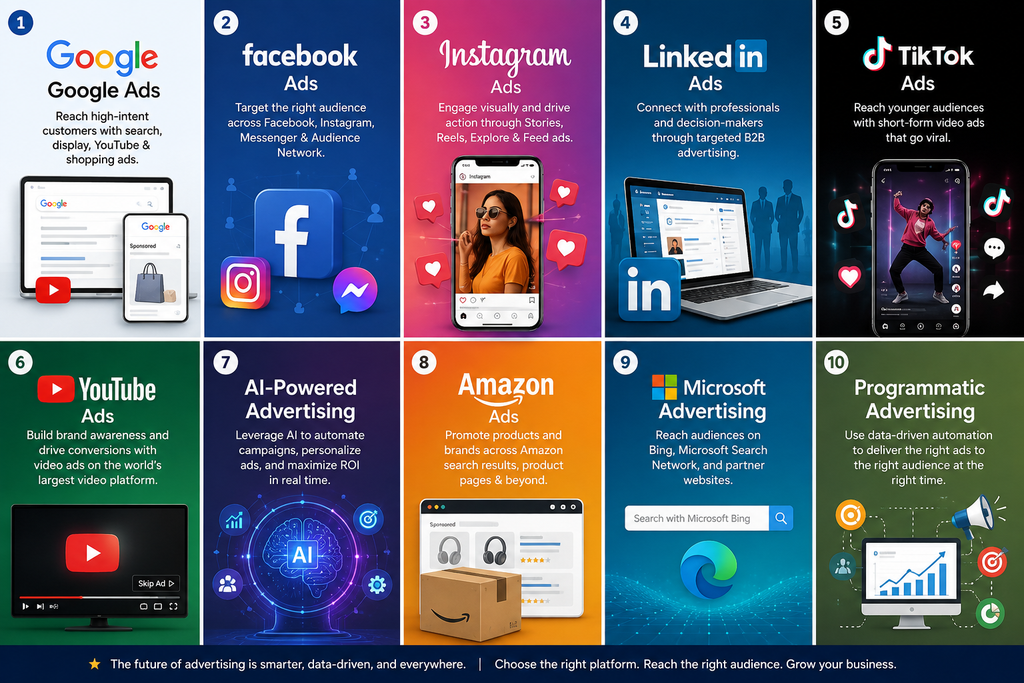
This news report ranks and analyses the top 10 advertising platforms shaping business strategies in 2026. The ranking draws from market share data, advertiser adoption trends, revenue figures, AI integration maturity, targeting precision, and practical ROI potential reported across industry analyses. Google and its ecosystem still command the largest overall footprint, particularly in high-intent search. Meta leads social and discovery. TikTok drives engagement among younger and creative-first audiences. LinkedIn dominates professional B2B. Amazon and retail media capture bottom-funnel commerce intent. Microsoft provides complementary search reach. Programmatic platforms enable open-web and cross-channel scale. Emerging AI-native experiences, X, and specialised visual or community platforms round out the landscape.
The defining story of 2026 is not merely platform competition but the deep integration of generative and agentic AI. Platforms now automate creative generation, bidding, audience expansion, and even conversational ad experiences. Advertisers who master these tools—while retaining strategic oversight—gain measurable advantages in efficiency and performance. Privacy shifts, cookieless environments, and first-party data strategies further influence choices. What follows is a detailed examination of each platform, its 2026 strengths, limitations, best-use cases, and the broader implications for businesses.
1. Google Ads: The High-Intent Foundation
Google Ads remains the cornerstone advertising platform for most businesses in 2026. With an estimated market share exceeding 35% in tracked online advertising technologies and handling roughly 8.5 billion searches daily, it captures users at the precise moment of commercial intent. Campaigns span Search, Performance Max, YouTube, Display Network, Discover, Gmail, and Maps under a unified interface.
The platform’s 2026 evolution centres on AI. AI Max for Search, which exited beta earlier in the year and became the default upgrade path for many legacy campaigns by September, expands targeting beyond strict keywords. It incorporates broad match intelligence, text customisation, final URL expansion, and creative optimisation while preserving advertiser controls. Internal data cited by Google indicates meaningful lifts in conversions—reports of 7% to 27% more conversions or conversion value at comparable cost efficiency depending on the baseline comparison. New Gemini-powered ad formats appear in AI Mode experiences, including conversational discovery ads, highlighted answers, and AI-powered Shopping ads that deliver contextual product guidance tailored to complex queries.
Performance Max continues to dominate for advertisers seeking automated, multi-channel reach. Demand Gen campaigns now benefit from expanded video format conversion (vertical to square or landscape) and Gemini recommendations for creative optimisation. Asset Studio and Ask Advisor (a Gemini-based agent spanning Ads, Analytics, Merchant Centre, and Marketing Platform) reduce operational friction. Businesses report that AI tools accelerate creative production and surface actionable insights on the homepage via personalised cards and conversational querying.
Strengths include unmatched search volume, sophisticated Smart Bidding, robust measurement (especially with enhanced conversions and privacy-safe signals), and seamless integration with Google Analytics and Merchant Centre. Limitations persist: steep learning curves for advanced features, competitive auction pressure that can inflate costs in popular categories, and ongoing debates about transparency in fully automated campaigns. Entry barriers are low—no fixed minimum spend—though meaningful results typically require budgets starting in the low thousands monthly for consistent testing and optimisation.
Best suited for lead generation, local services, e-commerce with existing demand, and any business where users actively search for solutions. Many experts advise treating Google as the non-negotiable first platform, supplemented by others for demand creation. In 2026, success increasingly depends on feeding high-quality first-party data and brand guidelines into the AI systems rather than manual keyword micromanagement.
2. Meta Ads (Facebook and Instagram): Scale, Discovery, and Creative Automation
Meta’s advertising platform, encompassing Facebook, Instagram, Threads, and related surfaces, ranks as the premier vehicle for demand generation and social commerce. Combined reach remains enormous—Instagram and Facebook each surpass or approach three billion users in various metrics, with the family of apps reporting billions of monthly actives. Meta captured a dominant share of social media ad revenue, with figures in the tens of billions and growth continuing into 2026.
Advantage+ automation suites and end-to-end AI creative ecosystems define the 2026 experience. At industry events, Meta showcased tools that learn brand identity from existing assets, generate new creatives, test variations, and optimise in real time using catalogue and contextual signals. Advertisers report strong returns, with some benchmarks citing average revenue of over $4 for every $1 spent in optimised campaigns, reflecting improvements over prior years. Creator partnership tools consolidated into a unified Marketing Hub streamline influencer and partnership ads. Video-first formats, particularly Reels, drive engagement, while shopping features and lead generation forms support full-funnel strategies.
Targeting relies heavily on behavioural signals, interests, and lookalike modelling refined by machine learning, compensating for privacy restrictions. Costs remain accessible relative to some competitors: average CPCs often range from under a dollar to low single digits depending on objective and audience, with flexible starting budgets.
Meta excels for e-commerce, DTC brands, consumer lead generation, retargeting, and broad awareness. It is less ideal for highly specialised B2B without careful audience layering. Creative fatigue occurs faster on these visual platforms, requiring frequent refreshes—now partially mitigated by AI generation. Measurement has improved with better attribution tools, though cross-platform and multi-touch challenges remain industry-wide.
In 2026 surveys, Facebook and Instagram consistently rank among the most important platforms for marketers by perceived importance and ROI, particularly for B2C. Businesses that combine strong creative testing with Meta’s automation tools frequently achieve scalable results that complement Google’s intent capture.
3. TikTok Ads: Engagement and Cultural Momentum
TikTok has solidified its position as a top-tier advertising platform through exceptional user engagement and discovery power. Daily time spent on the app often exceeds that of competitors, and short-form video formats deliver high impression efficiency. Advertising revenue growth has been among the fastest, with estimates placing it in the tens of billions globally and strong year-over-year increases.
In 2026, TikTok Ads emphasise native in-feed video, Spark Ads (boosted organic content), and shopping integrations. Creative excellence is non-negotiable: authentic, trend-aligned content outperforms polished traditional ads. The platform’s algorithm favours relevance and watch time, rewarding advertisers who invest in rapid creative iteration. AI tools assist with asset generation and optimisation, though human cultural fluency remains critical.
Costs are competitive—average CPMs frequently lower than Meta’s in many markets, with CPCs often in the sub-dollar to low-dollar range. Minimum recommendations around $20–$30 per ad group or higher for meaningful testing apply in key regions. Performance shines for e-commerce, awareness among Gen Z and Millennials, entertainment-adjacent brands, and products suited to visual demonstration.
Challenges include the need for continuous creative production, potential regulatory or geopolitical considerations in certain markets, and measurement that sometimes lags behind more mature platforms. Nonetheless, marketers increasing budgets for TikTok in 2026 cite its ability to drive both upper-funnel awareness and measurable conversions when creative aligns with platform culture. It pairs effectively with Meta for broader social coverage and Google for conversion capture.
4. LinkedIn Ads: Precision B2B Targeting
For B2B marketers, LinkedIn Ads stand alone in professional targeting depth. With over a billion members and strong adoption among decision-makers, the platform enables precise filters by job title, seniority, company size, industry, skills, and intent signals. In 2026 analyses focused on B2B, LinkedIn consistently appears as a core recommendation alongside Google Search.
Sponsored Content, Message Ads, Lead Gen Forms, and Conversation Ads support long sales cycles. Costs are higher—CPMs often $30–$65 and CPCs several dollars to double digits—reflecting audience quality. ROI justifies the premium for high-ticket services, software, professional services, and account-based marketing. Integration with tools providing predictive account scoring further enhances performance for enterprise teams.
AI enhancements improve audience recommendations and creative suggestions, though the platform’s automation maturity trails Meta and Google. Best results come from strong organic presence combined with paid amplification and rigorous lead nurturing. LinkedIn is rarely the sole platform but frequently the highest-ROI channel for qualified B2B pipeline when budgets support testing.
5. Amazon Advertising and Retail Media
Amazon Ads and the broader retail media category have matured into essential bottom-funnel platforms. Shoppers already in purchase mode on Amazon, or via Amazon DSP for broader reach, convert at high rates. Sponsored Products, Sponsored Brands, Sponsored Display, and DSP campaigns leverage first-party shopping data for precise targeting and measurement.
In 2026, retail media continues rapid growth as brands seek closed-loop attribution from impression to purchase. Amazon’s scale, combined with expanding inventory (including Twitch and other properties), makes it indispensable for e-commerce sellers and brands with products sold on or competing within Amazon’s ecosystem. Budgets can start relatively modestly for Sponsored Products, though DSP often involves higher minimums for managed services.
Strengths include intent proximity and robust reporting. Limitations include competition intensity for popular keywords and less effectiveness for pure brand-building outside commerce contexts. Many multi-channel strategies place Amazon alongside Google Shopping and Meta for full coverage of the path to purchase.
6. Microsoft Advertising
Microsoft Advertising (covering Bing, Yahoo, DuckDuckGo partnerships, Edge, and related properties) serves as the primary complementary search platform. Search volume is a fraction of Google’s, yet competition is thinner, often yielding lower CPCs and attractive incremental reach. Import tools allow seamless migration of Google campaigns, reducing setup friction.
In 2026, Microsoft continues AI investments aligned with broader ecosystem capabilities. It performs well for B2B, older demographics, and markets where Bing holds stronger share. Businesses already investing in Google frequently add Microsoft for efficient expansion without proportional cost increases. It ranks among top platforms by technology adoption metrics in various tracking studies.
7. YouTube Ads (Within the Google Ecosystem)
While technically part of Google Ads, YouTube warrants distinct attention as the dominant video advertising platform. Long-form and Shorts inventory, combined with sophisticated targeting and brand-lift measurement, support awareness, consideration, and direct response. In 2026, AI-assisted creative tools and expanded Demand Gen placements enhance efficiency. CPMs and view costs remain competitive relative to the quality of engaged audiences. It is particularly powerful for educational content, product demonstrations, and brands with higher average order values.
8. Programmatic Platforms and DSPs (The Trade Desk, Google DV360, StackAdapt, and Peers)
Open-web and omnichannel reach beyond the major walled gardens relies on demand-side platforms. The Trade Desk frequently ranks highest for independent, audience-first buying across display, video, CTV, audio, and digital out-of-home. Google’s Display & Video 360 integrates tightly with the Google stack. StackAdapt, Amazon DSP, Adform, and others offer specialised strengths in self-serve flexibility, commerce signals, or privacy-forward identity solutions.
In 2026, these platforms emphasise cookieless readiness, AI optimisation, and cross-channel orchestration. They suit agencies and larger brands needing inventory diversity, advanced audience modelling, and control outside pure social or search. Minimum spends and technical requirements are higher than self-serve social platforms, making them better for mid-market and enterprise teams.
9. X (Formerly Twitter) Ads
X provides real-time conversation and news-adjacent reach. Advertising tools support promoted posts, trends, and targeting around interests and conversations. Costs can be relatively efficient for engagement and awareness. In 2026, its role is more specialised—effective for timely campaigns, thought leadership, and audiences active in public discourse—rather than a primary volume driver. Adoption among marketers trails Meta, TikTok, and LinkedIn, but it remains relevant for certain verticals and real-time marketing needs.
10. Emerging and Specialised Platforms: AI-Native Experiences, Pinterest, and Beyond
The tenth category captures both established specialists and the rising AI frontier. Pinterest continues to deliver strong performance for visual discovery, lifestyle, home, fashion, and planning-oriented categories, with often lower CPCs and high commercial intent. Snapchat retains relevance for younger demographics and AR experiences. Reddit and community platforms offer niche, high-engagement opportunities.
Most significantly, 2026 marks the acceleration of advertising within AI-native interfaces. Generative search and conversational AI platforms—Google’s AI Mode and Overviews, ChatGPT and similar tools—have begun integrating sponsored answers, product recommendations, and agentic commerce experiences. Early revenue in generative search channels is measured in the low billions, with projections of rapid scaling toward tens of billions within a few years. Formats remain experimental: conversational discovery, highlighted answers, shopping guidance, and agent-mediated recommendations. Partnerships between AI platforms and ad tech providers, agencies, and measurement firms are forming quickly. Businesses monitoring these channels gain early-mover advantages as consumer research habits shift toward AI-mediated discovery.
Retail media networks beyond Amazon, connected TV platforms, and local or vertical-specific solutions (Yelp, Nextdoor for certain local businesses) provide additional options depending on goals.
Cross-Cutting Trends: AI, Measurement, and Strategy in 2026
Artificial intelligence is no longer a feature but the operating system of modern advertising. Generative tools produce images, video, copy, and variations at scale. Agentic systems plan, execute, and optimise campaigns within defined guardrails. Platforms compete on the quality of their AI models, data moats, and ease of integration with brand guidelines and first-party data. Advertisers must balance automation benefits against brand safety, creative authenticity, and strategic control. Those treating AI as a collaborator—providing clear briefs, high-quality inputs, and human oversight—outperform pure “set and forget” approaches.
Measurement has grown more sophisticated yet remains challenging. Privacy regulations and signal loss push greater reliance on modelled conversions, clean rooms, and incrementality testing. Multi-touch attribution across Google, Meta, TikTok, Amazon, and programmatic requires unified data strategies. Retail media’s closed-loop advantage and AI platforms’ emerging commerce integrations point toward tighter purchase connection.
Budget allocation in 2026 typically favours a core of Google plus Meta or TikTok for most consumer brands, LinkedIn plus Google for B2B, and Amazon for commerce-heavy businesses, with programmatic or specialised platforms filling gaps. Testing remains essential: platforms evolve quickly, and what works in one category or geography may differ elsewhere. Creative quality and relevance continue to matter more than ever; AI lowers production barriers but raises the competitive bar for originality and cultural fit.
Outlook and Recommendations
Looking ahead, the advertising landscape will further consolidate around ecosystems that combine scale, data, and AI sophistication while opening selective opportunities for specialised and AI-native entrants. Businesses should prioritise platforms matching their customer journey stage—search for intent, social and video for discovery and consideration, retail and commerce for conversion—while investing in first-party data infrastructure and creative testing velocity.
For small businesses, start with Google Ads and Meta, adding TikTok or Microsoft as resources allow. Mid-market and enterprise teams benefit from multi-platform orchestration, DSP access, and advanced AI tools. Continuous education on platform updates, rigorous experimentation, and focus on business outcomes over vanity metrics will separate leaders from the rest.
In 2026, the top advertising platforms are not static destinations but dynamic systems powered by AI and shaped by shifting consumer behaviour. Businesses that approach them strategically—selecting the right mix, feeding quality inputs, and measuring what matters—position themselves to capture attention, drive action, and grow amid intensifying competition. The winners will be those who treat advertising not as a cost centre but as an intelligent, adaptive engine for customer connection in an AI-augmented world.



Leave a Reply