
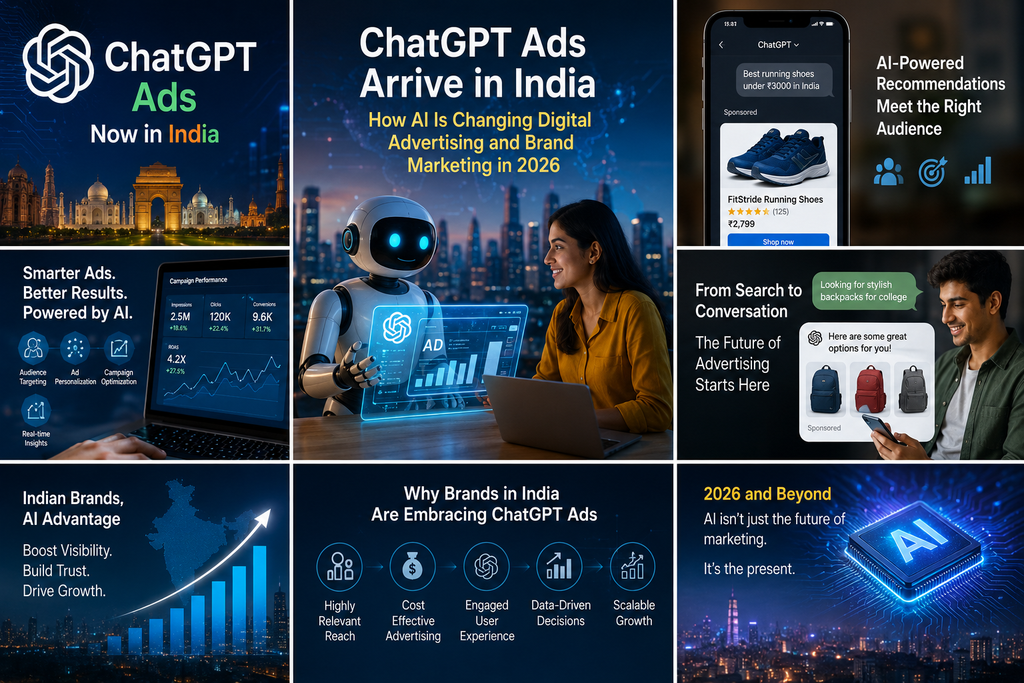
Ads began appearing for logged-in adult users on ChatGPT’s Free tier and its lower-priced Go plan (priced at ₹399 per month in India). Higher-paid subscriptions — Plus, Pro, Business, Enterprise and Education — remain ad-free. More than 50 brands are expected to go live in the initial wave, supported by OpenAI’s first agency partners in the market, WPP and Omnicom. A self-serve ChatGPT Ads Manager is scheduled to open on September 4, allowing businesses of varying sizes to run campaigns with daily budgets starting at ₹725.
The timing is deliberate. India ranks among ChatGPT’s largest and most active markets, with more than 100 million weekly active users reported earlier in 2026 and estimates of hundreds of millions of unique monthly users. OpenAI has invested heavily in the country, including the launch of the affordable Go plan and promotions that temporarily made it free for eligible users. Advertising is now positioned as a way to sustain broader access to the free and lower-cost tiers while building a revenue stream ahead of a planned public listing.
This is not simply another ad product bolted onto an existing platform. It represents a shift toward conversational, intent-driven advertising that sits inside the moments when people research, compare options, and form decisions. Combined with the rapid advance of generative and agentic AI across the broader advertising industry, ChatGPT’s entry into the Indian market illustrates how digital advertising and brand marketing are being reshaped in 2026.
The Mechanics of ChatGPT Ads
OpenAI has designed the product with clear guardrails intended to protect the core user experience. Sponsored content appears below a ChatGPT response when a relevant product or service exists. The ads are clearly labelled as sponsored and kept visually distinct from the organic answer. Critically, OpenAI states that ads do not influence the answers the model provides — “answer independence is non-negotiable.”
Advertisers do not receive access to individual conversations or personal details. They receive aggregate campaign metrics such as impressions, clicks, click-through rates and, over time, conversion-related data. Targeting draws on the immediate context of the conversation rather than traditional long-term behavioural profiles or pure keyword bidding. When a user expresses commercial intent — researching travel options, comparing financial products, seeking beauty recommendations or exploring retail purchases — a relevant sponsored message may surface.
Ads are withheld from users identified as or predicted to be under 18. They are also ineligible near sensitive or regulated topics, including mental health and politics. Users can dismiss ads and, in line with OpenAI’s broader principles, retain control over personalisation settings.
The Indian rollout follows an earlier pilot that began in the United States in February 2026 and subsequent expansion into dozens of markets across Europe, Asia and Latin America. By late August, OpenAI had rapidly added multiple new markets in a short window, with India representing one of the highest-volume opportunities.
For marketers, the proposition is different from conventional search or social advertising. Instead of bidding on keywords or building lookalike audiences from past behaviour, brands can insert themselves into high-context moments of active consideration. Dave Dugan, OpenAI’s head of global ads solutions, described the opportunity as enabling businesses “of every size” to introduce themselves “at relevant, high-context moments when decisions are beginning to take shape.”
Why India Matters
India’s scale and usage patterns make it strategically important. ChatGPT has become a daily tool for students, professionals, entrepreneurs, developers and consumers navigating everything from exam preparation and coding problems to product research and travel planning. The combination of a large free and low-cost user base with rising commercial intent creates a fertile environment for advertising.
OpenAI has signalled early advertiser interest across categories including travel, financial services, retail, and health and beauty. The agency partnerships with WPP and Omnicom bring established relationships with major brands and expertise in strategy, creative, measurement and brand safety. The non-exclusive nature of the partnerships leaves room for additional agencies as the programme matures.
The self-serve Ads Manager, launching shortly after the initial agency-led phase, is expected to open the platform to small and medium-sized businesses. A daily minimum of ₹725 lowers the barrier relative to many traditional digital channels and earlier high-minimum pilots in other markets. This structure reflects OpenAI’s stated aim of supporting both large enterprises and a long tail of smaller advertisers.
For Indian brands, the arrival coincides with the festive season planning cycle. Marketers locking budgets for the high-spending October-to-December period now have a new conversational channel to consider alongside search, social, retail media and connected television. Early experiments will test whether high-intent conversational placements can deliver stronger relevance and conversion signals than impression-based or keyword-driven formats.
The Broader Transformation of Digital Advertising in 2026
ChatGPT’s advertising debut in India sits inside a much larger industry shift. By 2026, artificial intelligence has moved from an experimental tool to an operational backbone across media planning, creative production, targeting, bidding and measurement.
Programmatic platforms and major social and search engines have long used machine learning for real-time bidding and audience modelling. In 2026, the capabilities have deepened. Agentic systems can interpret natural-language instructions, autonomously adjust budgets, pause underperforming campaigns and reallocate spend. Dynamic creative optimisation generates and tests large volumes of variants at low marginal cost. Predictive models identify high-probability converters without rigid demographic or interest definitions.
Generative AI has transformed creative workflows. Agencies and in-house teams produce hundreds of ad variations, localise messaging across languages and formats, and iterate far faster than traditional production cycles allowed. Industry surveys indicate that the majority of advertisers and agencies now deploy AI in creative processes, media planning and optimisation. Time previously spent on manual reporting, research and basic production is being redirected toward strategy and higher-value human judgment.
Consumer behaviour is also changing. Discovery is migrating from open-web search and social feeds into AI-mediated environments. AI overviews appear on a substantial share of traditional search results. Users increasingly begin research with conversational assistants that can synthesise information, compare options and, in some cases, guide or complete transactions. Early data points to higher conversion rates in certain AI-enabled shopping and recommendation experiences. This shift places pressure on traditional search traffic and rewards platforms that sit closer to decision-making moments.
Retail media networks, connected television and creator-driven formats continue to grow, but AI is increasingly the connective tissue that links them. Brands seek closed-loop measurement, first-party data strategies and the ability to optimise across channels in near real time. The result is an advertising ecosystem that is more automated, more personalised at scale, and more dependent on the quality of underlying models and data.
Implications for Brand Marketing
For brand marketers, the rise of conversational and agentic advertising raises both opportunity and complexity. High-context placements inside tools people already trust for research can deliver relevance that broad-reach channels struggle to match. Yet success depends on understanding how users actually converse with AI systems, what signals indicate commercial intent, and how to craft messages that feel helpful rather than intrusive.
Creative strategy must adapt. Ads that work in a conversational interface may differ from those optimised for feed scrolling or search results pages. Brands need to test messaging that aligns with the problem-solving or exploratory tone of many ChatGPT interactions. Measurement frameworks also require updating. Aggregate performance data from platforms like ChatGPT must be integrated with other channels, and attribution models must account for multi-touch journeys that now include AI-assisted research stages.
Smaller businesses gain potential access to sophisticated targeting and high-intent inventory that was previously harder to reach cost-effectively. Larger brands and agencies gain a new surface for consideration-stage influence. Both groups face the need to develop new skills: prompt-level understanding of user behaviour, creative systems that scale across AI environments, and governance frameworks that maintain brand safety and compliance in rapidly evolving interfaces.
Privacy and trust remain central. OpenAI’s insistence on keeping conversations private from advertisers and maintaining answer independence addresses a core concern. Users who rely on ChatGPT for sensitive or high-stakes queries need confidence that commercial incentives will not distort the information they receive. Clear labelling, age restrictions, topic exclusions and user controls are designed to support that confidence. How these principles hold as the business scales will be closely watched by regulators, advertisers and users alike.
Challenges and Open Questions
Several challenges accompany the opportunity. Relevance quality will determine whether users accept the ads or develop fatigue and dismissal habits. Early metrics from other markets have been cited as encouraging on trust and dismissal rates, but India presents its own linguistic diversity, device mix, connectivity patterns and cultural expectations around advertising.
Competition among AI platforms is intensifying. Other large language model providers and AI assistants are exploring or testing advertising and commercial integrations. Traditional search and social platforms continue to evolve their own AI features and ad products. The relative share of attention and commercial activity that settles inside pure conversational interfaces versus hybrid AI-overviews or other formats remains uncertain.
Measurement maturity is still developing. Aggregate metrics provide a starting point, but advertisers will push for richer conversion tracking, offline attribution and incrementality testing. Integration with existing ad-tech stacks, agency workflows and brand safety tools will influence adoption speed.
Regulatory scrutiny is inevitable. Advertising inside AI systems raises questions about transparency, data use, age-appropriate experiences and the potential for subtle influence. India’s digital advertising and data-protection landscape, combined with global developments, will shape the rules of engagement.
Finally, the economics of the free and low-cost tiers depend on advertising performing well enough to support continued investment in model quality and capacity. OpenAI has framed advertising as a means of expanding access rather than maximising time spent. Balancing user experience with sustainable monetisation will be an ongoing test.
Looking Ahead
The arrival of ChatGPT ads in India is both a local commercial milestone and a signal of broader industry direction. In 2026, digital advertising is no longer primarily about capturing attention on pages or feeds. It is increasingly about participating in the moments when people use AI systems to learn, decide and act.
Brand marketing is adapting accordingly. Strategies that once centred on reach and frequency now emphasise relevance within decision journeys, creative systems that generate and optimise at scale, and measurement that accounts for AI-mediated influence. Agencies are building new capabilities around conversational environments, agentic campaign management and brand safety in AI interfaces. Technology providers are racing to supply the targeting, creative, measurement and compliance tools that the new landscape demands.
For Indian consumers, the change will be gradual and visible primarily as occasional sponsored suggestions appearing beneath useful answers. For marketers, it opens a new high-intent channel at a time of significant festive and year-end planning. For OpenAI, it advances a dual goal: supporting free and affordable access while building a substantial advertising business.
Whether conversational advertising ultimately delivers superior returns, maintains user trust and scales into a major revenue line will be determined by execution over the coming months and years. What is already clear is that artificial intelligence has moved from the margins of digital advertising into its core. The platforms people use to ask questions, explore options and form preferences are becoming commercial surfaces. Brands that learn to participate thoughtfully — respecting the context of conversation, prioritising genuine usefulness and measuring impact rigorously — will be best positioned for the next phase of digital marketing.
As self-serve tools open and more brands experiment, India will serve as one of the most important laboratories for this new form of advertising. The results will influence not only OpenAI’s trajectory but the wider evolution of how brands reach and engage audiences in an AI-mediated world.
The conversation has begun. The advertising layer has now been added. How both users and marketers respond will shape the future of digital advertising and brand marketing well beyond 2026.




Leave a Reply