
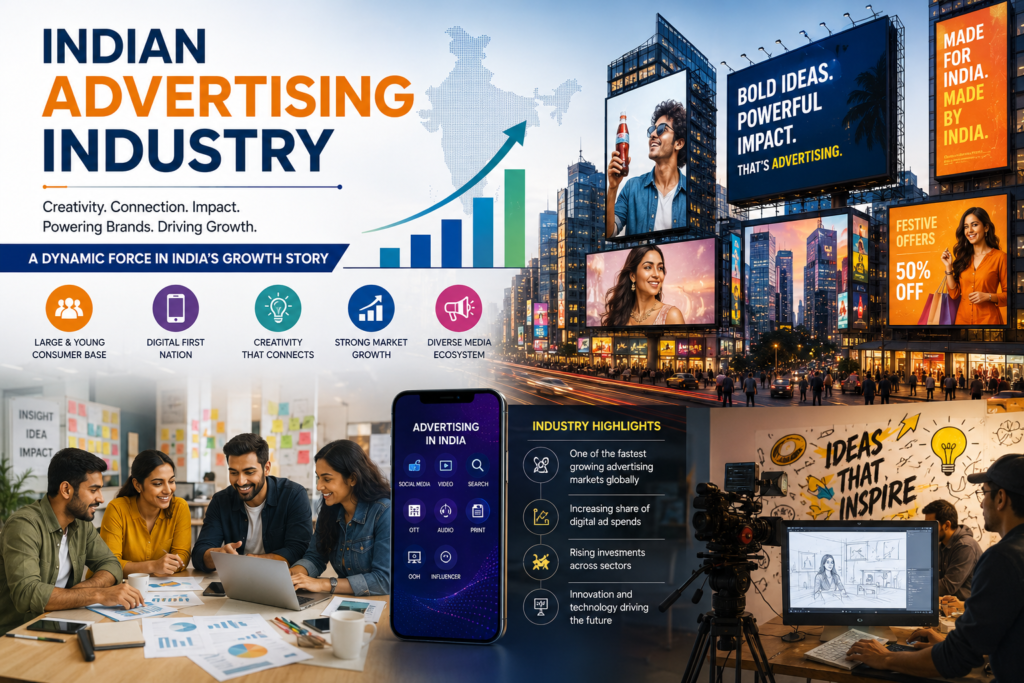
Indian Advertising Industry Progress in 2026: Digital Transformation, AI, and Consumer Growth Drive a New Era
As businesses compete for consumer attention across multiple platforms, advertising has become more data-driven, technology-enabled, and performance-focused than ever before. Industry analysts estimate that India’s advertising market is growing at a strong pace and is expected to remain among the fastest-growing advertising markets globally throughout the decade. Digital advertising, in particular, continues to dominate new investments, while television, outdoor media, radio, and print are adapting through integrated and hybrid strategies.
Industry Size and Growth Momentum
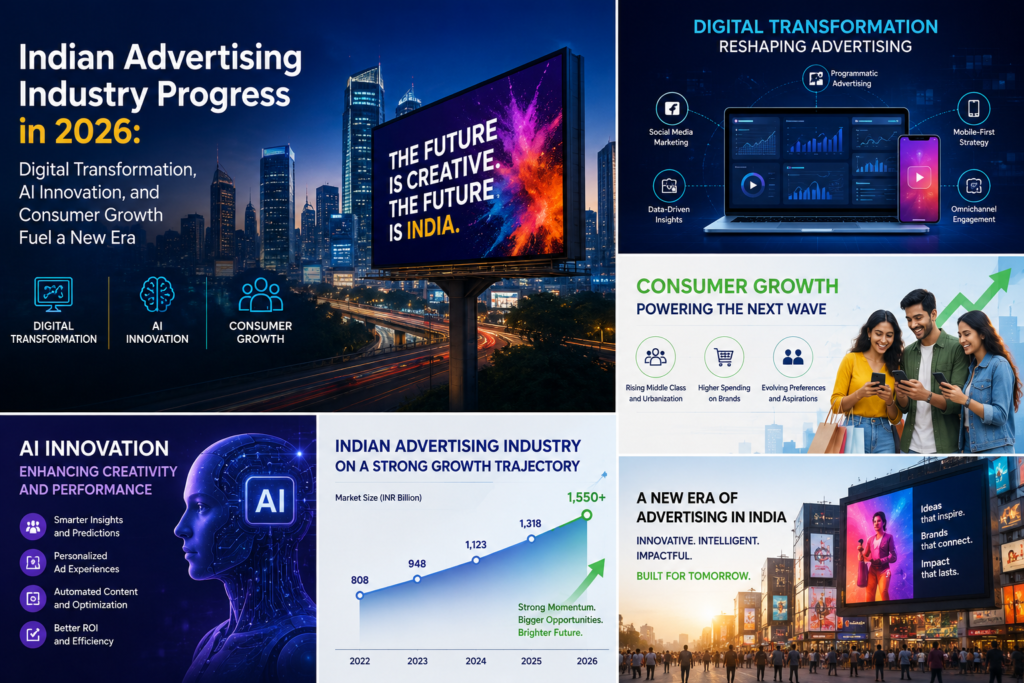
The Indian advertising market entered 2026 with strong momentum following robust growth in 2025. Industry reports estimate that the overall advertising market exceeded ₹1 trillion in value and is projected to maintain double-digit growth during the coming years. The country’s expanding consumer economy, rising disposable incomes, and increasing digital consumption are creating unprecedented opportunities for advertisers and media companies.
India’s position as one of the world’s fastest-growing major economies has provided a favourable environment for advertising expansion. Consumer-facing industries such as FMCG, e-commerce, automobiles, telecommunications, financial services, healthcare, education, travel, and entertainment continue to increase their marketing budgets to capture market share in an increasingly competitive landscape.
The advertising ecosystem now includes traditional agencies, digital marketing firms, media-buying companies, influencer networks, AI-powered marketing platforms, retail media operators, and content creators, creating a dynamic and highly diversified industry.
Digital Advertising Becomes the Dominant Force
The most significant development in 2026 is the continued rise of digital advertising. Industry estimates suggest that digital advertising spending in India is approaching or exceeding $5 billion, making it the fastest-growing segment of the advertising market. Mobile advertising remains the primary driver due to India’s smartphone-first internet ecosystem.
Several factors are contributing to digital advertising growth:
- Increased smartphone penetration
- Affordable mobile data
- Growth of e-commerce
- Expansion of digital payment systems
- Rising video consumption
- Growth of regional-language content
- Advanced audience targeting technologies
Platforms such as search engines, social media networks, streaming services, gaming apps, and e-commerce marketplaces continue to attract significant advertising investments as brands seek measurable returns on marketing expenditure.
Experts note that digital advertising is no longer viewed as an alternative channel but as the central component of modern marketing strategies.
Mobile-First Advertising Shapes Campaign Strategies
India’s internet growth story remains heavily mobile-driven. Most consumers access digital content through smartphones, making mobile devices the most important advertising medium in the country.
Brands are increasingly designing campaigns specifically for mobile screens rather than adapting content created for television or desktop platforms. Vertical video formats, interactive advertisements, short-form content, and mobile commerce integrations are becoming standard marketing tools.
According to industry reports, mobile advertising accounts for the majority of digital advertising expenditures, reinforcing India’s position as a mobile-first digital economy.
AI Revolution Transforms Advertising
Artificial intelligence is reshaping the Indian advertising industry in 2026. AI-powered tools are being used across nearly every stage of the advertising process, including:
- Consumer research
- Audience segmentation
- Creative development
- Campaign optimization
- Media planning
- Customer engagement
- Performance measurement
AI enables marketers to analyse massive amounts of consumer data in real time and deliver highly personalised advertising experiences. Automated campaign management systems can optimise budgets and placements faster than traditional methods.
Global technology leaders are introducing AI-powered advertising products that are influencing marketing strategies worldwide, including in India. AI-generated creative content, predictive analytics, and automated audience targeting are becoming increasingly common across campaigns.
Industry experts believe AI will continue to improve efficiency while helping brands achieve higher returns on advertising investments.
Influencer Marketing Enters a New Phase
Influencer marketing has evolved from an experimental strategy into a mainstream advertising channel in 2026. Brands across sectors increasingly collaborate with creators, social media personalities, industry experts, and regional influencers to build consumer trust and engagement.
The creator economy has become one of the most influential forces in modern advertising. Global trends indicate that creators are now playing a central role in brand communication strategies, with marketers allocating larger budgets to influencer-led campaigns.
India’s vast social media ecosystem provides brands with access to audiences across different languages, regions, and demographic groups. Regional influencers, in particular, are gaining importance because they offer strong connections with local audiences.
Key benefits of influencer marketing include:
- Higher engagement rates
- Authentic storytelling
- Improved brand trust
- Better conversion performance
- Stronger regional reach
As a result, influencer partnerships are becoming a permanent feature of advertising strategies rather than one-time promotional activities.
Rise of Retail Media Networks
One of the fastest-growing segments of advertising in 2026 is retail media. E-commerce platforms and retail ecosystems are increasingly monetising their consumer data by offering targeted advertising opportunities to brands.
Retail media allows advertisers to reach consumers at critical stages of the purchase journey. This capability makes retail advertising highly attractive because it combines marketing exposure with measurable sales outcomes.
Globally, retail media is among the fastest-growing advertising categories, and similar trends are emerging in India as online commerce continues to expand rapidly.
Major retailers, marketplaces, and quick-commerce platforms are investing heavily in advertising technologies that enable brands to target shoppers with precision.
Video Advertising Continues to Expand
Video remains the most powerful advertising format in India. Short-form video content, streaming platforms, connected television, and digital video networks are attracting growing advertiser interest.
The increasing popularity of:
- OTT platforms
- Connected TVs
- Online sports streaming
- Short-video applications
- Regional entertainment content
has created new opportunities for brands to engage consumers through visual storytelling.
Industry forecasts indicate that video advertising will remain one of the fastest-growing segments within digital marketing because consumers increasingly prefer video-based content over static formats.
Brands are allocating larger budgets toward video production and distribution as they seek greater consumer engagement.
Regional Language Advertising Gains Strength
One of the defining characteristics of India’s advertising industry in 2026 is the growing importance of regional-language content.
As internet access expands beyond metropolitan areas into Tier-2, Tier-3, and rural markets, advertisers are increasingly creating campaigns in local languages to connect with diverse audiences.
This trend reflects the reality that millions of new internet users are more comfortable consuming content in regional languages than in English.
Brands are investing in:
- Multilingual campaigns
- Localised content creation
- Regional influencer partnerships
- Vernacular video marketing
The regionalisation of advertising is helping companies improve customer engagement while expanding market penetration across India.
Traditional Media Remains Relevant
Despite the rapid growth of digital advertising, traditional media continues to play a significant role in India’s advertising landscape.
Television
Television remains highly influential, particularly for mass-market brands. Major sporting events, entertainment programming, and national broadcasts continue to attract large audiences.
Print Media
Although print advertising faces challenges from digital transformation, newspapers continue to maintain strong readership in many Indian cities and regions. Print remains valuable for local advertising and certain consumer segments.
Radio
Radio advertising remains effective for local businesses, regional campaigns, and urban commuters.
Outdoor Advertising
Out-of-home (OOH) advertising is undergoing modernisation through digital billboards, programmatic buying systems, and smart-city infrastructure. Digital out-of-home advertising is becoming increasingly sophisticated and measurable.
Rather than competing directly, traditional and digital channels are increasingly integrated into omnichannel advertising strategies.
Sports Advertising Drives Spending
Sports remain one of the most important drivers of advertising expenditure in India.
Major events such as:
- Cricket tournaments
- International sporting competitions
- Football leagues
- Kabaddi leagues
- Esports tournaments
attract substantial advertising investments from leading brands.
Sports advertising provides advertisers with a massive audience reach and high engagement levels. The combination of television broadcasting, digital streaming, social media engagement, and influencer content creates comprehensive marketing opportunities.
Industry analysts expect sports-related advertising to remain a major growth catalyst in 2026 and beyond.
Growth of Programmatic Advertising
Programmatic advertising is becoming increasingly important as brands seek greater efficiency and precision in media buying.
Programmatic platforms use automated technology to purchase advertising inventory in real time based on audience characteristics and campaign objectives.
Benefits include:
- Better targeting
- Real-time optimization
- Improved measurement
- Reduced waste
- Higher efficiency
As marketers prioritise performance and accountability, programmatic advertising adoption continues to accelerate across India.
Consumer Privacy and Data Challenges
While data-driven advertising offers significant advantages, privacy concerns are becoming increasingly important.
Advertisers must navigate:
- Data protection regulations
- Consumer consent requirements
- Cookie restrictions
- Transparency expectations
Industry participants are investing in privacy-compliant advertising solutions that balance personalisation with consumer trust.
Contextual advertising, first-party data strategies, and AI-powered targeting solutions are emerging as important alternatives to traditional tracking methods.
Employment and Talent Development
The advertising industry’s growth is generating employment opportunities across multiple disciplines, including:
- Digital marketing
- Content creation
- Data analytics
- Media planning
- Graphic design
- Video production
- Influencer management
- AI marketing technologies
India’s large pool of creative and technology talent continues to attract investments from global advertising networks and marketing technology companies.
At the same time, industry leaders emphasise the need for continuous skill development as AI and automation reshape job requirements.
Outlook for the Future
The future of India’s advertising industry appears exceptionally promising. Continued economic growth, expanding internet access, increasing consumer spending, and technological innovation are expected to support sustained industry expansion.
Several trends are likely to shape the next phase of growth:
- Greater AI integration
- Expansion of retail media networks
- Continued rise of creator-led marketing
- Growth in regional-language advertising
- Increased use of predictive analytics
- Expansion of connected television advertising
- Stronger focus on commerce-driven marketing
- Greater adoption of immersive technologies
Industry forecasts suggest that India will remain one of the world’s most attractive advertising markets, supported by its large consumer base, digital transformation, and rapidly evolving media ecosystem.
Conclusion
The Indian advertising industry in 2026 stands at the intersection of creativity, technology, and consumer engagement. Digital platforms, artificial intelligence, influencer marketing, retail media, and mobile-first strategies are transforming how brands communicate with consumers.
While traditional media continues to play an important role, the industry’s centre of gravity has clearly shifted toward digital ecosystems powered by data and technology. The rise of regional content, creator economies, and AI-driven personalisation is opening new opportunities for brands and agencies alike.
As India advances toward becoming one of the world’s largest consumer markets, its advertising industry is poised for continued growth, innovation, and global significance. The year 2026 represents not merely another phase of expansion but the beginning of a new era in Indian advertising—one defined by digital excellence, technological innovation, and deeper consumer connections.
===



Leave a Reply