

Amazon India, the Indian arm of the global e-commerce and technology giant Amazon.com, Inc., has become a cornerstone of India’s digital economy since its full launch in 2013. Operating as Amazon.in, it has transformed retail, empowered millions of small businesses, created jobs, and accelerated the country’s shift toward a digital-first marketplace. With massive investments exceeding $40 billion to date and plans for an additional $35 billion by 2030, Amazon India stands as a key player in the nation’s “Atmanirbhar Bharat” (self-reliant India) and “Viksit Bharat” (developed India) vision.
This article delves into Amazon India’s history, business model, operations, achievements, challenges, leadership, societal impact, and future outlook, providing a detailed portrait of one of India’s most influential companies.
Historical Background and Entry into India
Amazon was founded by Jeff Bezos in 1994 in Bellevue, Washington, initially as an online bookstore named Cadabra before rebranding to Amazon, inspired by the mighty Amazon River. The company went public in 1997 and rapidly expanded beyond books into music, videos, electronics, and a vast array of consumer goods, pioneering innovations like 1-Click shopping, Prime membership, and Fulfilment by Amazon (FBA).
Amazon’s presence in India began earlier than the consumer-facing launch. In 2003, it established its first development centre in the country. In 2012, it acquired Junglee.com, a price-comparison platform, as a stepping stone. The official e-commerce site, Amazon.in, launched on June 5, 2013, starting with books, movies, and TV shows, before quickly expanding to electronics and more categories.
Entry was shaped by India’s regulatory environment. Foreign direct investment (FDI) rules restricted foreign ownership in multi-brand retail, leading Amazon to adopt a marketplace model focused on third-party sellers rather than owning inventory for most sales. This allowed compliance while building scale. Early challenges included building trust in online shopping, navigating logistics in a vast and diverse country, and competing with local players like Flipkart.
By 2016, Jeff Bezos announced an additional $3 billion investment, bringing the total to over $5 billion at the time. Amazon navigated regulatory hurdles, including scrutiny over its seller relationships and a failed major acquisition attempt involving Future Retail in 2019-2020 due to competition concerns.
Business Model and Key Offerings
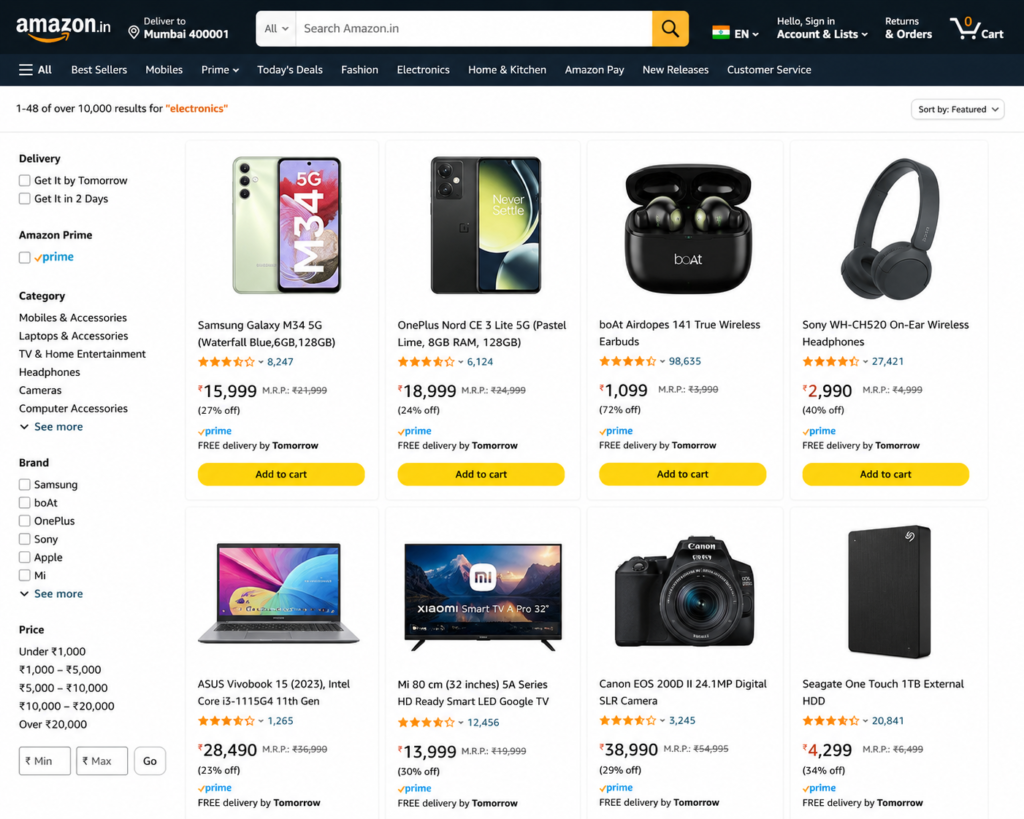
Amazon India’s core is a robust marketplace model. Unlike a pure retailer, it connects buyers with millions of sellers, earning through commissions, fulfilment fees, advertising, and value-added services. Third-party sellers drive the majority of sales, benefiting from Amazon’s infrastructure.
Key pillars include:
- Prime Membership: Offers fast delivery, exclusive deals, and entertainment via Prime Video. Variants like Prime Lite cater to budget-conscious users. Prime Day has become a major annual event.
- Fulfilment by Amazon (FBA): Sellers store products in Amazon’s warehouses; Amazon handles picking, packing, shipping, and customer service. This has been crucial for scaling in India.
- Logistics and Delivery: Amazon has built an extensive network with over 100 fulfilment centres, micro-fulfilment centres, and Amazon Air (dedicated cargo). Services like Amazon Now offer ultra-fast delivery in minutes in select cities, expanding to 100 cities with over 1,000 micro-centres. Same-day delivery covers millions of items in metros, reaching 20,000+ pin codes.
- AWS (Amazon Web Services): While global AWS is a profit powerhouse, in India, it supports cloud infrastructure for businesses, data centres, and AI initiatives.
- Devices and Entertainment: Echo, Fire TV Stick, Kindle, and Prime Video tailored for Indian content, including regional languages.
- Seller Tools and AI: Free AI assistants for sellers, zero referral fees on millions of products, and programs like Amazon Saheli for women entrepreneurs.
Amazon has localised aggressively: support for multiple Indian languages, cash-on-delivery (popular early on), UPI integration, and focus on “Made in India” products for global exports.
Scale and Statistics (as of 2025-2026)
As of recent data, Amazon India hosts around 218,000 active sellers offering over 168 million products, serving more than 150 million active customers. It delivers to nearly every serviceable pin code in the country.
The company has digitised over 12 million small businesses and enabled cumulative e-commerce exports exceeding $20 billion (ahead of targets), with a new goal of $80 billion by 2030. Over 200,000 Indian exporters have sold hundreds of millions of “Made in India” items globally.
In 2024, Amazon supported approximately 2.8 million jobs (direct, indirect, induced, and seasonal) in India. It plans to create an additional 1 million jobs by 2030 through its investments.
Market share in India’s e-commerce is estimated at 30-35%, trailing Flipkart but competing fiercely, especially in fashion, electronics, and groceries. Initiatives like Amazon Bazaar target value-conscious buyers in Tier 2/3 cities.
Leadership and Workforce
Amit Agarwal has been a pivotal figure, serving as Senior Vice President for International Emerging Markets (including India) and expanding roles in seller services. Local leadership, including country managers, has driven adaptation.
Amazon India employs thousands directly and supports lakhs through its ecosystem. It emphasises safety with air-conditioned facilities, rest centres (Ashray), and wellness programs. The company has been recognised as a top workplace in India. Benefits include upskilling, mental health support, and diversity initiatives like ElevateHER.
Impact on India’s Economy and Society
Amazon India has been a catalyst for digital inclusion. It empowers small and medium businesses (SMBs) by providing access to national and global markets without high upfront costs. Programs like “I Have Space” turn local stores into delivery hubs.
It has boosted exports, supported women entrepreneurs, and invested in infrastructure like data centers and AI tools for 15 million small businesses. Educational AI programs target government school students.
During the COVID-19 pandemic, Amazon played a vital role in delivering essentials while expanding services like Amazon Food.
Environmentally, efforts include greener logistics, though broader Amazon faces scrutiny on sustainability.
Challenges and Controversies
Amazon India has faced regulatory battles over FDI compliance, seller data practices, and competition laws. The Future Retail deal faced hurdles from the Competition Commission of India.
Criticisms include allegations of favoring certain sellers, counterfeit products, labor conditions in the broader ecosystem, and intense competition from Flipkart (Walmart), Reliance, and quick-commerce players like Blinkit. Cash burn in a price-sensitive market and adapting to rural India have been hurdles.
Global issues like data privacy, antitrust, and worker rights echo in India.
Future Plans and Innovations
In December 2025, Amazon announced over $35 billion in investments by 2030, focusing on AI-driven digitization, exports, and jobs. This builds on prior commitments and includes expanding Amazon Now, more fulfillment centers, AI for sellers and shoppers (like Rufus), and premium offerings.
Expect deeper penetration into Tier 2/3 cities, growth in grocery and fashion, enhanced Prime Video with regional content, and integration of advanced AI and robotics in logistics. Sustainability and inclusive growth remain priorities.
Conclusion
From a 2013 launch focused on books to a comprehensive ecosystem touching millions of lives, Amazon India exemplifies customer obsession, long-term thinking, and innovation tailored to local needs. It has reshaped consumer habits, empowered entrepreneurs, and contributed significantly to India’s GDP and digital infrastructure.
While challenges persist in regulation, competition, and execution, Amazon’s scale, technology, and commitment position it strongly. As India’s economy grows, Amazon India is poised not just to participate but to lead in creating a more connected, efficient, and prosperous digital marketplace. Its story is intertwined with India’s digital transformation—one of mutual growth and ambition.
==




Leave a Reply