
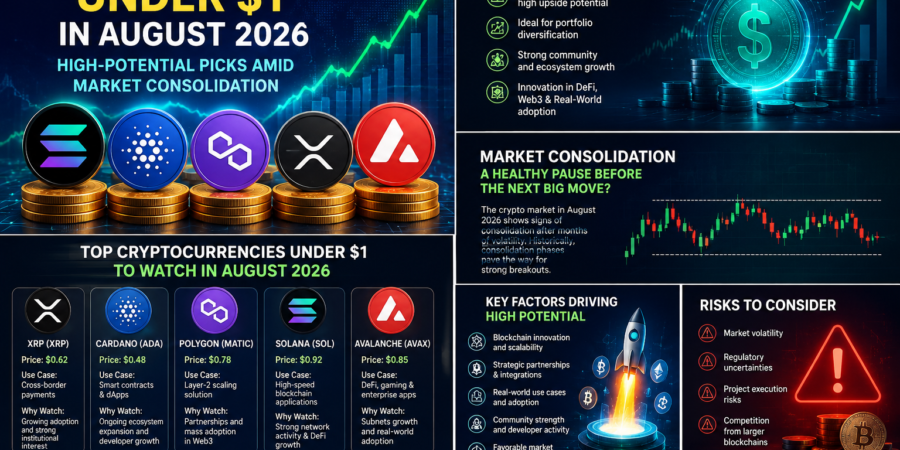
This report examines the landscape of low-value cryptocurrencies under $1 with elevated future return potential, drawing on recent market data, project fundamentals, analyst commentary, and sector trends as of early August 2026. It covers market context, deep dives into selected projects, mathematical considerations around market caps, risk factors, and forward-looking scenarios. All figures are approximate and subject to rapid change; readers must conduct independent research and treat this as informational only, not financial advice.
Market Context: Why Sub-$1 Tokens Capture Attention in 2026
The cryptocurrency market in mid-2026 reflects a period of selective recovery and narrative rotation. After peaks in prior cycles, many tokens remain substantially below all-time highs, creating entry points for patient capital. Low unit prices enable smaller investors to accumulate larger quantities, amplifying percentage gains if demand materialises. However, experts consistently emphasise that a $0.10 token with a multi-billion-dollar market cap may offer less percentage upside than a $0.02 microcap with genuine product traction, provided liquidity and fundamentals support growth.
Key narratives driving interest include real-world asset tokenisation (projected by consulting firms toward multi-trillion-dollar potential over the longer term), high-throughput Layer-1 scalability, enterprise blockchain adoption, decentralised storage and compute, AI-adjacent infrastructure, and persistent meme-driven speculation. Institutional involvement has increased through ETFs, partnerships, and regulated products in certain jurisdictions, yet regulatory clarity remains uneven globally. Liquidity varies widely: larger sub-$1 names trade hundreds of millions daily, while microcaps can suffer from thin order books and extreme volatility.
According to aggregated market snapshots around early August 2026, prominent sub-$1 tokens by market capitalisation include names such as Canton, Ondo, Polkadot (near or fluctuating around the threshold in some listings), Mantle, Kaspa, and others. Circulating supplies often run into the billions or tens of billions, meaning a move to $1 implies substantial valuation expansion. For instance, a token with 20 billion circulating supply requires a $20 billion market cap at $1—achievable for top-tier projects but demanding significant capital inflows and sustained demand.
Analysts note that the most compelling opportunities combine undervalued unit prices with either proven usage (transaction volume, total value locked, enterprise partnerships) or clear catalysts (upgrades, listings, regulatory developments, or narrative alignment). Purely speculative plays, especially memes with no product, carry the highest risk of permanent impairment. Position sizing discipline—often limiting small-cap exposure to 10-15% of a crypto portfolio, diversified across several holdings—is widely recommended by experienced market participants.
Cardano (ADA): Research-Driven Smart Contracts Platform Seeking Momentum
Cardano (ADA), trading in the approximate $0.16–$0.21 range in early August 2026 with a multi-billion-dollar market capitalisation, remains one of the more liquid and established sub-$1 Layer-1 networks. Built on a research-oriented approach emphasising peer-reviewed protocols, formal verification, and a proof-of-stake consensus (Ouroboros), Cardano aims for scalability, sustainability, and interoperability.
The network has maintained high mainnet uptime over multiple years and continues development on governance, smart contracts, and ecosystem tools. Recent price action has shown periods of support testing and recovery attempts, with some technical observers highlighting reclaimed long-term levels that historically preceded larger moves. Whale accumulation has been noted in certain periods alongside fluctuating on-chain activity.
Price predictions for the remainder of 2026 vary widely. Some models project averages near $0.30 by year-end under base-case assumptions of continued development and broader market improvement, with higher targets in bullish scenarios tied to ecosystem expansion or regulatory tailwinds. Longer-term technical projections from chart analysts have referenced multi-year upside potential reaching several dollars if structural uptrends reassert, though such outcomes depend on execution and macro conditions. Historical seasonal patterns and resistance zones around previous highs factor into near-term analysis.
Cardano’s strengths include a large developer community, academic grounding, and focus on emerging-market use cases. Challenges encompass competition from faster or more heavily funded chains, past criticisms of slower feature rollout relative to peers, and the need for greater transaction volume and decentralised application traction to justify higher valuations. Its relatively large circulating supply means percentage gains require correspondingly large capital flows. Still, for investors seeking exposure to a mature smart-contract platform trading well below prior cycle peaks, ADA frequently appears on “under $1 with potential” lists due to its liquidity and established brand.
Hedera (HBAR): Enterprise-Grade Hashgraph for Tokenisation and Institutional Use
Hedera (HBAR) trades roughly in the $0.06–$0.09 range with a market capitalisation in the low billions. Powered by the hashgraph consensus algorithm rather than traditional blockchain, it prioritises high throughput, low fees, fair ordering, and energy efficiency—attributes attractive to enterprises. A governing council of major corporations provides decentralised oversight, distinguishing it from many pure decentralised projects.
Hedera has pursued real-world asset tokenisation, supply-chain tracking, digital identity, and payments use cases. Institutional interest manifests through partnerships, potential ETF developments in some markets, and positioning within regulated financial infrastructure. On-chain activity and pilot programs form the core of its value proposition, though conversion of enterprise pilots into scaled, fee-generating usage remains a key watchpoint.
Analyst forecasts for 2026 often cluster in the mid-to-high single-digit cents for base cases, with more optimistic scenarios pointing toward $0.15–$0.30 or higher if tokenisation volumes accelerate and the network captures a meaningful share of institutional settlement activity. Longer-term ceilings discussed in valuation frameworks reach toward $1 or beyond under exceptional adoption of RWA and enterprise DLT, implying market-cap expansion into the tens of billions. Risks include slower-than-expected conversion of partnerships into sustained demand for the HBAR token itself, competition from other enterprise chains, and general market risk.
HBAR’s enterprise focus and council structure appeal to investors prioritising fundamental utility over pure speculation. Its price remains a fraction of its historical peak near $0.57, leaving theoretical room if adoption metrics improve.
Kaspa (KAS): High-Throughput BlockDAG Proof-of-Work Contender
Kaspa (KAS), priced around $0.02–$0.04 in recent data with a market cap in the mid-to-high hundreds of millions, stands out for its blockDAG (Directed Acyclic Graph) architecture using the GHOSTDAG protocol. This enables parallel block creation, delivering high throughput, rapid confirmations, and low fees while retaining proof-of-work security and decentralisation. Launched fairly without pre-mine or heavy VC allocation, it has cultivated a strong community and growing hashrate.
Development focuses on further scalability (targeting higher blocks per second), programmability upgrades including smart-contract capabilities, and ecosystem expansion via funding programs for dApps. Transaction volumes and active addresses have shown periods of notable growth. Analysts highlight its technical differentiation in the scalable PoW category and potential institutional interest if mining and infrastructure mature.
Price targets for 2026 span a wide range: conservative scenarios remain near current levels or modest gains, while optimistic cases reference $0.10–$0.50 or approaches toward $1 under strong ecosystem development and favourable market conditions. Reaching $1 would require a market cap in the mid-to-high tens of billions given the large circulating supply (tens of billions of tokens), placing it in elite territory and necessitating broad adoption. Some longer-horizon views discuss multi-dollar possibilities if it becomes a default high-speed PoW network with robust applications.
Kaspa’s fair-launch ethos and performance claims attract technical investors, but risks include limited current smart-contract maturity relative to competitors, the mathematical challenge of supply size for high unit prices, and competition in the Layer-1 space. It exemplifies a project where unit price under $1 masks substantial absolute valuation already achieved, yet further gains remain plausible with continued technical progress.
Ondo (ONDO): Leading the Real-World Asset Tokenisation Charge
Ondo Finance’s ONDO token trades near $0.35–$0.40 with a market capitalisation approaching $2 billion in recent snapshots. The protocol specialises in tokenising U.S. Treasuries, equities, ETFs, and other traditional assets, bridging traditional finance and on-chain markets. Products such as yield-bearing stablecoin alternatives and tokenised stock offerings have driven significant total value locked (TVL) growth into the multi-billion-dollar range, with market-share leadership reported in certain tokenised equity segments.
Institutional traction includes partnerships or integrations involving major asset managers, regulatory progress (including broker-dealer authorisations), and expansion into perpetual trading and broader distribution. The RWA sector itself has expanded rapidly, with on-chain tokenised assets reaching tens of billions in aggregate value. Ondo’s positioning as one of the more visible publicly traded tokens in the space draws attention.
Forecasts for ONDO reflect both platform success and token-specific dynamics. Base cases for late 2026 often sit near or modestly above current levels, while bullish scenarios tied to fee-switch mechanisms, continued AUM growth, and broader RWA adoption reference reclaims of prior highs near $2 or higher over multi-year horizons. Challenges include token unlock schedules that can create selling pressure, the distinction between platform growth and direct token value accrual, and competition from both crypto-native and traditional finance entrants into tokenisation.
ONDO illustrates how a sub-$1 price can coexist with substantial absolute valuation and clear product-market fit in a high-growth narrative. Its future returns hinge heavily on whether governance and tokenomics evolve to capture more of the platform’s economic activity.
Other Notable Contenders and Microcap Speculation
Several additional projects frequently surface in under-$1 discussions. Stellar (XLM), trading near $0.17, focuses on fast, low-cost cross-border payments and has expanded RWA rails with measurable volume metrics. Filecoin (FIL), nearer $0.70, provides decentralised storage and benefits from ongoing demand for data permanence. Polygon (POL, successor to MATIC concepts) and others in the scaling or interoperability space trade under $1 with established ecosystems.
On the higher-risk, higher-reward end, microcap tokens with market capitalisations in the single-digit to low tens of millions—such as certain AI-data, privacy (fully homomorphic encryption-related), gaming/verified-user, or pure meme projects—offer mathematical potential for outsized multiples. Names appearing in recent “cheapest cryptos” or “1000x potential” roundups include projects focused on verified human data for AI/gaming, AI training data marketplaces, privacy layers, and speculative memes. These can deliver extreme percentage moves on relatively modest capital inflows due to low floats or circulating market caps, but they also exhibit extreme volatility, unlock overhangs, delisting risks, and in many cases limited or no fundamental product traction. Pure memes depend almost entirely on social momentum and can collapse rapidly.
Mathematical Realities, Risks, and Investment Considerations
Unit price under $1 creates psychological accessibility, yet investors must calculate implied market caps at target prices. A project needing only a few hundred million dollars in valuation to reach $1 faces a lower bar than one requiring tens of billions. Conversely, large-supply tokens demand correspondingly large absolute capital to move the price meaningfully.
Risks are substantial across the board: regulatory actions, technological failures or delays, competition, liquidity crises, macroeconomic downturns, and project-specific issues such as team execution or token unlocks. Microcaps amplify these dangers with higher chances of illiquidity or abandonment. Historical crypto cycles show that even fundamentally strong projects can experience 80-90%+ drawdowns. Diversification, position sizing, and a long-term horizon (or active risk management for shorter-term trades) are essential.
No projection constitutes a guarantee. Price predictions from various models often diverge sharply, reflecting differing assumptions about adoption rates, market cycles, and token utility capture. Broader crypto market health—particularly Bitcoin dominance, liquidity conditions, and risk appetite—typically influences altcoin performance more than isolated project news in the short to medium term.
Outlook: Selective Opportunities in a Maturing Market
Looking ahead from August 2026, the sub-$1 segment offers a spectrum of risk-reward profiles. Established names like Cardano, Hedera, Kaspa, Stellar, and Ondo provide relatively higher liquidity and clearer fundamental narratives tied to smart contracts, enterprise DLT, scalable PoW, payments, and RWA tokenisation—sectors with multi-year growth potential. Microcaps and speculative tokens present lottery-ticket upside at the cost of elevated failure probability.
Success for any of these will likely require a combination of continued technical or product delivery, favourable regulatory and macroeconomic conditions, and sufficient capital rotation into altcoins. Investors monitoring on-chain metrics (active addresses, transaction volumes, TVL, hashrate), development roadmaps, partnership announcements, and token unlock calendars will be better positioned to assess evolving potential.
The allure of low-value cryptocurrencies with high future return potential persists because crypto markets have repeatedly rewarded early identification of undervalued infrastructure and narratives. Yet the path is rarely linear, and capital preservation must remain paramount. As the industry matures, differentiation through genuine utility rather than mere low price will increasingly separate sustainable projects from transient hype. Continuous due diligence, scepticism toward exaggerated claims, and alignment with personal risk tolerance remain the most reliable guides in this dynamic landscape.
(Market data and forecasts are time-sensitive approximations based on publicly available reporting as of early August 2026 and subject to change. This report is for informational and educational purposes only and does not constitute investment, financial, or trading advice. Cryptocurrency investments carry a high risk of loss. Always verify current data from primary sources and consult qualified professionals before making decisions.)



Leave a Reply